Choosing an EA for a Prop Firm
Updated
The best EA for prop firms isn't necessarily the robot with the most impressive screenshot. A strategy can look attractive and still be a poor fit for your account's drawdown model, trading costs or permitted methods. Before comparing products, decide what the software needs to do and what evidence would change your mind. That gives you a way to reject unsuitable tools without getting pulled into a debate about which advertised pass rate looks highest.
Instead of asking for the best EA for prop firms in isolation, start with the account and the operating conditions. This guide compares strategy types, testing evidence, execution risks and ongoing costs. It doesn't present an invented vendor ranking or claim hands-on tests that haven't taken place. You'll get a framework for reading reports, asking better questions and running a fair demo comparison. A useful shortlist should explain why each candidate fits, as well as what would make you stop using it.
EA selection checklist
| Strategy Type | Risk Profile | Compatibility With Strict Limits |
|---|---|---|
| Fixed-Risk Trend | Predictable/Calculated | High compatibility with defined drawdown |
| Mean-Reversion | Variable/Event-Based | Requires strict duration and trend filters |
| Grid/Martingale | Catastrophic/Exponential | Highly likely to breach loss limits |
| Modular Hybrid | User-Controlled | Best for firm-specific rule adaptation |
| High-Frequency | Slippage-Sensitive | Difficult to maintain under strict rules |
Define what best means for your account
Finding the best ea for prop firms requires shifting focus away from marketing claims and toward your specific account limitations. You must define what best actually means based on your risk tolerance and the firm rules. A strategy that generates consistent profit might still violate a drawdown limit if the position sizing is too aggressive. Start by reading your provider documentation regarding permitted trade styles and prohibited practices. This initial step prevents selecting an automated tool that could get your account terminated for non-compliance. Clearly define your objectives before evaluating any software to maintain a disciplined approach to your trading journey. For platform-specific checks, see the prop firm EA MT5 guide. For a wider product overview, read the prop firm EA review.
Your account rules dictate the parameters that any software must respect to avoid disqualification. For example, some firms enforce a 5% daily loss limit based on your previous day balance. You need to ensure your setup never exceeds this threshold even during volatile market sessions. A high-performance bot that fails to account for these specific constraints will not serve your needs. Always prioritize capital preservation over aggressive growth because losing your funded status creates more financial damage than a missed opportunity. Treat your evaluation phase as a rigorous test of your risk management framework rather than a simple profit chase.
Verify built-in risk safety
The best ea for prop firms must demonstrate resilience when market conditions become erratic or unpredictable. Look for systems that incorporate built-in stop loss logic and position sizing filters that adapt to your equity balance. If the software cannot automatically cap your downside based on current account constraints, you will likely struggle to pass the assessment. Test these safety features on a practice account to confirm they function as expected during high-impact news releases. Do not trust marketing claims about performance without verifying that the protective mechanics truly align with the strict rules set by your funding partner.
Practical scenarios involve assessing how your setup handles a losing streak while adhering to daily and overall drawdown limits. Imagine a situation where your bot encounters 5 consecutive losses. Does it continue to trade with the same risk, or does it throttle down? A robust tool should include an automatic pause feature or a risk reduction mechanism after a specific loss threshold is reached. By setting clear criteria for when to intervene manually, you maintain control over the account destiny. Relying on software without a human-monitored override strategy leaves you exposed to avoidable risks that often lead to account failure.
Separate an entry robot from a risk manager
Distinguishing between an entry engine and a risk manager is vital for building a stable portfolio for your account. An entry robot focuses purely on identifying potential price trends or mean reversion points to execute orders. However, these tools often lack the sophisticated risk management needed to satisfy strict prop firm rules. A standalone entry bot might lack features like trailing stops or account-wide daily loss limits. Integrating an independent risk manager allows you to layer protective rules over any entry strategy, creating a hybrid setup that is significantly more robust and compliant.
When using the best ea for prop firms, consider how your risk manager monitors open positions in real time. It should oversee every trade regardless of the entry signal source to ensure no violation occurs. For instance, if you have multiple positions open, a dedicated risk manager can close them all if the total equity drops by a specific percentage. This capability is missing in many basic entry bots. By separating the logic, you gain the ability to swap or upgrade your entry system without having to recalibrate your core risk management settings or protective exit protocols.
Manage total account exposure
A worked example demonstrates the importance of this separation. Suppose your entry robot is designed to trade 3 different currency pairs simultaneously. If the market shifts, all 3 might hit their stop loss at the same moment. Without a risk manager monitoring the aggregate exposure, you might accidentally breach your daily drawdown limit on that trade cycle. A secondary risk management layer acts as an emergency circuit breaker that monitors the total account equity. This layer ensures that the combined loss of all active positions remains within the safe parameters defined by your funding firm.
Troubleshooting your strategy setup becomes much easier when you keep these functions distinct. If your system is failing to exit trades correctly, you immediately know whether to adjust the entry parameters or the risk management logic. This modular approach saves significant time during testing. It also allows you to perform stress tests on your risk manager independently to see how it responds to extreme slippage or sudden account equity drops. By isolating the entry and management components, you build a professional infrastructure that supports long-term growth and keeps you within the necessary compliance boundaries.
Build a shortlist without invented rankings
Building a shortlist for the best ea for prop firms requires ignoring paid advertisements and artificial vendor rankings. Instead, create your own evaluation criteria based on empirical evidence and rule compliance. Start by filtering potential tools based on their public track record and transparency regarding their internal logic. Ask vendors for a detailed explanation of their risk parameters and how they handle slippage or high-volatility events. A trustworthy developer will provide clear documentation, not vague promises of guaranteed returns. This objective filtering process helps you find a system that actually serves your specific goals and risk profile.
Evaluate the quality of the backtesting data provided by each candidate on your shortlist. Does the report use real tick data and variable spreads, or does it rely on simple OHLC bar testing? A professional setup should be tested against at least 3 years of high-quality historical data. Look for clear evidence of out-of-sample performance, which shows how the system adapts to new market regimes. If the creator cannot provide this, it is safer to move on. Professional traders rely on verifiable data, not on curated equity curves that ignore the reality of trading costs and execution slippage.
Match system to trading personality
Once you have a list of candidates, focus on the trade-offs of each system. One might offer a high win rate but suffer from a large maximum drawdown, while another might have a lower win rate with tighter risk controls. There is no perfect system. You must choose the one that aligns with your personality and your firm's specific rules. For example, if you struggle with patience, a high-frequency system might be too stressful to monitor. Always prioritize systems that provide clear, logical entry and exit reasons rather than those that function like a black box.
Finally, check the responsiveness of the vendor to technical questions. If you cannot get a straight answer about how a tool manages weekend gaps or high-impact news, do not buy it. A good developer understands that the best ea for prop firms must be maintainable by the user. Test their support by asking specific questions about adjusting risk parameters or handling specific account equity limits. If they are evasive or dismissive, assume the product is not suitable for a funded environment where precise control is a necessity. Only move forward with developers who value transparency and technical clarity.

Score the evidence rather than the advert
Assessing the best ea for prop firms demands that you treat all marketing collateral with deep skepticism. An advertisement featuring a flawless, upward-sloping equity curve is rarely a reliable indicator of future results. Focus your scoring on the underlying evidence, such as the profit factor, the average trade duration, and the total number of trades executed over a long period. A system that shows only 20 trades over 2 years is statistically insignificant and should be disqualified from your list. Professional evaluation requires a large enough sample size to ensure the results are not just a product of luck.
Scrutinize the drawdowns shown in the evidence provided. Does the system experience long periods of stagnation, or are the drawdowns clustered around specific market events? Look for evidence of how the software behaved during known periods of high volatility or sudden news spikes. A system that failed to maintain its edge during these events is a liability. You need to understand the failure modes of the system before you commit capital to an evaluation. If the vendor cannot provide these specific performance metrics, the system is not suitable for a serious trader.
Account for real trading costs
Consider the impact of trading costs on the presented results. Many ads ignore spreads, commissions, and potential slippage. A profitable strategy on paper can quickly become a losing one when these real-world costs are factored in. When scoring your options, manually adjust the provided performance results by adding realistic costs for the symbols you plan to trade. If the system is still profitable after these adjustments, it might be worth further investigation. This simple step separates viable strategies from those that only look good in a hypothetical environment without transaction costs.
Create a scoring matrix to compare the systems you have researched. Assign points for categories like risk management robustness, documentation quality, historical data transparency, and ease of use. Do not just look at the net profit column. A strategy that makes 10% with a 5% max drawdown is often superior to one that makes 20% with a 15% max drawdown. This is true when dealing with strict prop firm rules. By using a weighted score, you make a rational decision based on your personal risk comfort. This is essential for surviving the evaluation process.
Compare fixed-risk trend strategies
Fixed-risk trend strategies offer a stable path for traders searching for the best ea for prop firms. These systems typically aim to capture significant price moves while keeping the downside strictly capped on every trade. Because they use a predefined risk amount per order, they are much easier to manage against daily loss limits. A well-designed trend system will have a clear entry signal based on indicators like moving averages or breakout channels. It will also have a hard stop loss placed at the moment of entry to protect your capital from unforeseen volatility.
The primary advantage of these strategies is their simplicity. You know exactly what your worst-case scenario is for every single trade. When comparing different trend systems, look for those that have a high profit-to-loss ratio. Since they will likely have a lower win rate, you need big winning trades to offset the frequent small losses. This is the nature of trend following. If you cannot handle a period of multiple small consecutive losses, this approach may not be the right fit for your psychological profile or your risk tolerance.
Filter trades during sideways markets
When you evaluate these strategies, pay close attention to how they handle entries in different market conditions. Some perform well in strong, trending markets but fail miserably during ranging or choppy sessions. Ask yourself if the strategy includes a filter to avoid trading when the market is sideways. A good trend-following system should have logic that recognizes when a trend is losing steam, allowing it to move to the sidelines. Without this, the system will bleed capital through constant false signals during consolidation phases, eventually leading to a breach of your drawdown limits.
A worked example of risk management: if you have a $50,000 account and a 1% risk limit per trade, you can risk $500. A fixed-risk trend EA should calculate position size based on this $500 limit. It must also consider the distance to the stop loss. If the stop is 50 points away, the position size is determined by the point value. This logic must remain consistent. Always verify that the system does not override your risk settings during high-volatility events. A reliable system should never let a single trade exceed your predetermined threshold.
Compare mean-reversion approaches
Mean-reversion strategies can be highly effective when hunting for the best ea for prop firms, but they require careful handling. These systems profit from the assumption that prices will eventually return to their historical average after an extreme move. They often have a higher win rate than trend-following systems because they aim to capture small, frequent reversals. However, this comes with the danger of a larger single loss if the market refuses to reverse and instead enters a powerful, sustained trend. You must ensure your system has robust exit rules for these rare, high-impact events.
When evaluating these systems, look for how they define an 'extreme' price move. Is it based on standard deviations, RSI levels, or historical support and resistance zones? The more robust the logic, the better the system will perform across different assets. Avoid systems that rely solely on a single indicator, as they are prone to over-optimization. A professional mean-reversion system often uses multiple factors to confirm the reversal, such as volume spikes coinciding with price exhaustion. This helps to filter out noise and improve the probability of successful trades in live market environments.
Implement trend-aware trading stops
Troubleshoot your chosen system by testing it against historical periods where the market trended strongly for weeks on end. Did the system stay out, or did it try to catch the knife? A good mean-reversion tool should have a 'stop-trading' condition when the market structure changes significantly. If the system keeps entering against a clear, strong trend, it will eventually drain your account equity. Understand that the best mean-reversion systems are not always in the market. They wait for high-probability setups, which is a sign of a disciplined and well-developed strategy that preserves capital.
Consider the role of time-based exits in mean-reversion strategies. Sometimes a trade doesn't hit its target but stays open too long, tying up margin and creating potential risk. An intelligent system should have a maximum trade duration limit. If the price does not revert to the mean within a set timeframe, the system should close the trade regardless of the profit or loss. This ensures that your account capital is always available for the next high-probability setup rather than being stuck in a dead-end, stagnating position.

Assess grids, martingale and recovery sizing
When researching the best ea for prop firms, you will inevitably encounter grid and martingale systems. These strategies increase position sizing after a losing trade, hoping that a final, larger win will cover previous losses and generate a profit. While these can produce very smooth-looking equity curves for a while, they carry catastrophic risk. A single prolonged losing streak can cause the position size to grow so large that it breaches your maximum drawdown limits or exhausts your account margin entirely. Most professional traders consider these approaches too dangerous for the strictly regulated environment of a prop firm account.
If you are tempted by these systems, perform a rigorous stress test. Simulate a 10- or 15-trade losing streak. Calculate the required margin and the total potential loss for the final trade in that sequence. Does it fit within your firm's rules? Usually, the answer is no. Martingale systems are often designed to work in ideal conditions but fail spectacularly when market volatility spikes or when the market moves against the grid for an extended period. The risk of ruin is simply too high for a professional approach to funding, where capital preservation is the absolute priority.
Avoid risky martingale recovery methods
Recovery sizing techniques are a milder form of martingale. You should still approach these with extreme caution. These systems might increase risk slightly after a loss. However, they rely on the gambler's fallacy that a win is due. Even a well-programmed system creates an unpredictable risk profile for your account. You might start a trading session with a 1% risk plan. You could end the day with 5% exposure because the system kept adding to a losing trade. This inconsistency makes it impossible to accurately manage your risk in accordance with firm requirements.
A final warning: many providers explicitly restrict or prohibit strategies that rely on martingale or complex recovery grids. Using such a tool can lead to an immediate account ban, even if you are technically in profit. If you must explore these strategies, do so only on a demo account that perfectly mirrors your firm's rules. Never risk your funded status on a system that relies on exponentially increasing your exposure. A stable, consistent risk management plan is always superior to a strategy that relies on luck and aggressive recovery to survive a rough patch.
Inspect stop logic and catastrophic exposure
The stop logic is the single most important feature of the best ea for prop firms. You must verify that your system uses hard stop orders, not just virtual stops calculated by the software. A virtual stop relies on the EA remaining connected and active to send an exit command to the broker. If your internet connection drops or your computer crashes, the stop will not execute. A hard stop resides on the trading server, ensuring that your position is closed even if your terminal goes offline. Always confirm that your strategy uses this server-side protection for every open order.
Inspect how the system handles catastrophic events, such as a major currency flash crash or a central bank surprise announcement. Does it have an emergency 'kill switch' that closes all positions if the total drawdown hits a certain level? A professional system should have this as a mandatory feature. You don't have time to manually intervene during a market crash. The EA must be programmed to handle the worst-case scenario autonomously. Test this by setting a very tight loss limit in your demo account and observing how the EA responds when that threshold is breached.
Validate handling of partial fills
Pay attention to the system's response to partial fills or slippage. In volatile markets, your stop might not fill at the exact price you requested. A poorly written EA might get confused by a partial fill. It could fail to close the remaining part of the position, leaving you exposed to further losses. Ensure the code is robust enough to handle these common market realities. A good way to test this is to run the EA on a live, small-dollar account. Do this during an active news session after you have extensively verified the logic in a safe, controlled environment.
Lastly, check if the system monitors for 'ghost' orders or duplicate entries after a terminal restart. If your EA accidentally opens a second position because it didn't correctly sync with the server, your risk doubles instantly. This simple software error is a common cause of blown accounts. When you test the best ea for prop firms, force a terminal restart while a trade is active. Observe if the EA correctly identifies the open trade and resumes its management without creating new, unintended orders. This is a basic test, but it is critical for ensuring your automated system is truly safe for live trading.
Compare drawdown fit across products
The best ea for prop firms must be chosen by assessing how the strategy's drawdown profile fits the specific products offered by your firm. Different firms use different methods to calculate drawdown. Examples include end-of-day trailing or high-water mark equity. You must understand which method applies to your account. Select a strategy that inherently respects that calculation. A strategy that is profitable but has high intraday volatility might trigger a breach under an intraday drawdown rule. This can happen even if it ends the day with a profit. Always match your EA's behavior to the firm's specific drawdown tracking methodology.
Consider the asset classes you are trading. A strategy that works well for currency pairs with high liquidity may fail on exotic assets with wider spreads. The drawdown profile will change significantly based on the symbol. If you are trading a prop firm account that offers a wide range of products, select a strategy optimized for symbols that have tightest spreads and consistent liquidity. This reduces the risk of slippage causing a sudden, unexpected hit to your equity. Such an event could trigger a breach of your drawdown limit. Stick to major instruments to ensure your EA remains predictable.
Prefer strategies with smooth drawdowns
Analyze the historical drawdown frequency of your chosen system. Does it have a slow, steady decline during its losing phases, or does it suffer from occasional, deep drops? A strategy with deep, sudden drops is much riskier, especially if you are close to your account's maximum allowed loss. You want a strategy that exhibits 'smooth' drawdowns. This allows you time to intervene if you notice that the system is entering a phase of poor performance. If a strategy's drawdown happens almost instantly, you won't have time to react, making it unsuitable for a high-stakes, funded trading account.
Troubleshooting a drawdown mismatch: if you find that your EA is breaching the daily limit, investigate the cause. It might be due to the strategy's inherent volatility or taking too many trades at once. You might need to limit the number of simultaneous orders. You could also reduce the position size during high-risk periods. It is often a configuration issue, not a strategy failure. By adjusting the settings to fit your firm's specific drawdown rules, you turn a potentially losing strategy into one that is compliant and effective. Continually monitor your performance against the firm's specific thresholds to ensure your ongoing success.

Read backtests as controlled experiments
Treat backtests as rigorous experiments. You must isolate specific variables instead of simply viewing a final profit number. Most traders looking for the best ea for prop firms focus solely on total gain. This ignores the underlying structural risks of the strategy. A valid experiment demands you define the market regime and specific symbols used. You must also apply the commission structure to your data. If you ignore bid-ask spreads or potential slippage, your backtest is just a theoretical estimate. It is not a practical guide for your actual funded account.
When assessing these backtests, you must account for the difference between in-sample and out-of-sample data. A strategy that is heavily over-optimized to fit a specific period will almost certainly fail when applied to new market conditions. You should look for systems that maintain consistent performance across varying levels of volatility. If the equity curve only rises during specific low-volatility periods, you are looking at a system with a very limited operational shelf life. Always prioritize robustness over the perfection of a single historical curve.
Test profitability after transaction costs
Consider the impact of transaction costs on your results during the evaluation phase. Many automated systems rely on small profit targets that are easily wiped out by commissions and swap charges. You need to simulate these costs accurately to see if the strategy retains any real edge. If the profit factor drops below 1.2 after accounting for realistic trading costs, you should reconsider the setup. Small variations in execution cost often define the difference between a long-term viable system and one that quickly burns through your capital.
Finally, ensure your simulation accounts for the specific stop-loss and take-profit logic of the asset classes you plan to trade. If the EA uses dynamic exits that rely on tick data, you must use high-quality tick-based testing software to see how the system behaves under pressure. Avoid trusting the results if they rely on unrealistic assumptions about how prices move during major news events. A disciplined approach to backtesting provides a baseline for expectations that helps you avoid emotional reactions during a real, live market drawdown.
Evaluate demo and forward evidence
Transitioning from a backtest to a forward demo environment is a critical step in your validation process. Even if you believe you have found the best ea for prop firms, you must prove it works in real-time under current market spreads. Use a demo account provided by the firm you intend to challenge to ensure the latency and execution speed match your expectations. Watching how the system handles live slippage provides far more insight than any static test file ever could.
Keep a detailed journal during your forward testing phase to track how the system handles different market phases. Note down when the system enters and exits trades, and check if these actions align with the logic you observed in your simulations. If the strategy consistently fails to hit your target profit due to unexpected slippage, you need to adjust your expectations immediately. A good forward test should run for at least 4 to 6 weeks to catch different types of market environments.
Monitor VPS stability and execution
Monitor the resource consumption of the software during your forward trials to prevent technical failures. An EA that requires heavy CPU usage can lead to terminal freezes, which may prevent your stop-loss orders from triggering correctly. Check your VPS logs daily to ensure the software remains connected and that the order execution is behaving as intended. If you notice any weird gaps in your trade history or failed entries, stop the testing immediately until you isolate the cause of the issue.
Document every single trade taken during the forward test. This allows you to perform a thorough post-mortem analysis later. Compare your actual results against the expected behavior you defined before starting the trial. If the system deviates from its planned risk parameters, ask yourself why. Did the environment cause the error or is the code fundamentally flawed? This structured approach allows you to make informed decisions. You can then decide whether to risk your own capital on a firm-funded account or discard the system.
Measure execution sensitivity and costs
Execution costs often go overlooked by those seeking the best ea for prop firms. Yet, they are the silent killers of many trading strategies. Every time your EA opens a position, you pay a spread and likely a commission. If your strategy trades frequently with small profit targets, these costs will quickly accumulate. They can negate your statistical edge. Always calculate your break-even point by including these friction costs. This ensures that your winning trades are actually profitable after all fees are deducted.
Slippage is another critical factor that you must incorporate into your cost measurement model. During periods of high volatility, the price you get might be significantly worse than the price you expected. If your EA does not account for this by building a buffer into its entry logic, your performance will suffer during news events. Run a test where you simulate negative slippage to see how resilient your strategy remains when market liquidity thins out or spreads widen.
Adjust for liquidity-based costs
Analyze the symbol specifications provided by your firm to understand how costs fluctuate throughout the trading day. Some instruments have much wider spreads during the Asian session, which can trigger stop-losses prematurely if your settings are too tight. A robust strategy will either pause trading during these low-liquidity periods or factor in the wider costs when calculating position sizes. Being aware of these timing-based cost variations allows you to optimize your EA settings for better overall performance.
Lastly, compare your broker's raw spreads against the prices your EA actually achieves in the market. There is often a discrepancy caused by the delay between the signal generation and the order reaching the execution server. If this lag is too high, it might be impossible to successfully use that specific strategy on that platform. Focus on systems that are not overly sensitive to minor price fluctuations to ensure that your trading plan remains consistent regardless of daily market noise.
Check platform, symbols and VPS needs
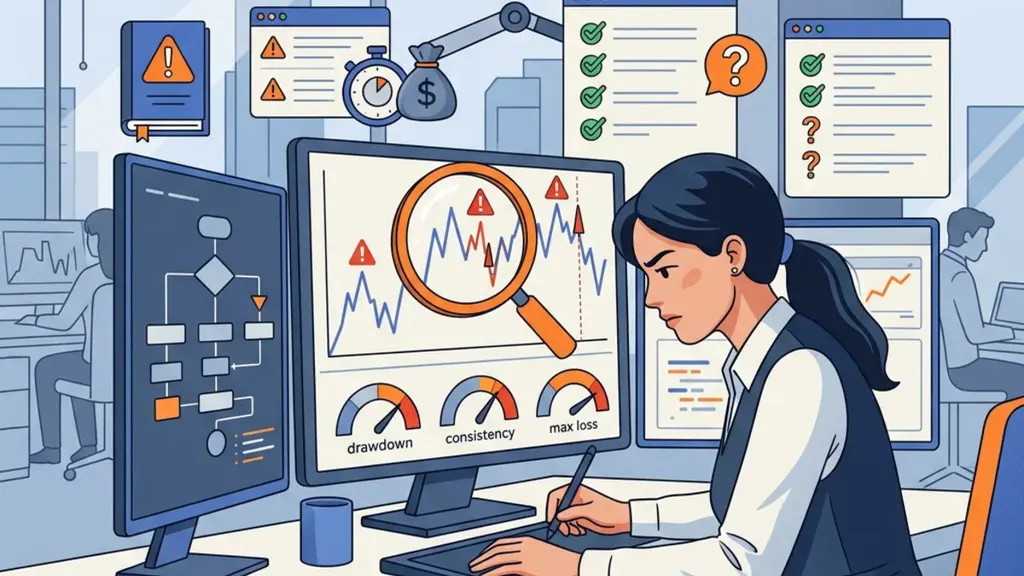
Your infrastructure setup is the foundation upon which your automated strategy rests. When you look for the best ea for prop firms, you must ensure your chosen platform supports the specific coding requirements of the system. This applies to MT4, MT5, or cTrader. Some bots are platform-specific. Trying to use a port that was not designed for your broker's infrastructure can lead to catastrophic execution errors. Always verify compatibility before committing to a specific firm or a new software purchase.
Choose a VPS location that is physically close to your broker’s data center to minimize latency. Even a difference of 20 milliseconds can significantly impact your entry prices, especially for scalp-style strategies. You should also check the resource specifications of the VPS to ensure it has enough RAM and CPU power to handle your terminal without lagging. A sluggish server can miss order updates or fail to send close signals at the right time, leading to unwanted open exposure.
Confirm symbol and contract settings
Symbol availability varies by provider, so verify that your EA is set up to trade the specific instruments permitted by your account. If the EA expects a currency pair that your firm does not offer, the code may fail or behave unpredictably. You should also check the symbol contract specifications, such as lot sizes and point values, to make sure your position sizing logic remains correct. Discrepancies here can lead to orders being much larger or smaller than you initially intended.
Ensure you have a robust backup plan for when your internet connection or VPS fails. Ideally, configure your EA to use server-side stop-losses and take-profits. These remain active even if your local computer disconnects from the trading server. Never rely solely on internal EA logic to close trades if the client terminal manages the exit. A well-configured setup protects your risk at the broker level. This shields your account from unexpected technical failures during critical market moments.
Read licensing, support and refund terms
Due diligence extends beyond the software code to the vendor's business practices. When searching for the best ea for prop firms, always read the fine print regarding licensing and support. A lifetime license might seem appealing, but if the vendor disappears or stops updating the code, your investment becomes worthless. Look for vendors who offer transparent update schedules and clear communication channels, as you will inevitably need assistance when market conditions change or bugs are discovered in the software.
Refund policies are a major indicator of a vendor's confidence in their product. Avoid sellers who demand that you waive your right to a refund just to access the software. A reputable provider understands that a strategy might not fit every trader's style or risk profile. They should provide a fair period for you to test the software on a demo account before the purchase becomes final. If they are overly defensive about their refund policy, treat it as a significant red flag.
Require support regarding risk controls
Examine the level of support provided by the vendor regarding account configuration and rule compliance. While the vendor cannot know your firm's specific rules, they should be able to explain how their code interacts with account limits like daily loss caps. If the support team cannot answer technical questions about how the EA manages risk, you should look elsewhere. You need a partner who understands the technical constraints of automated trading, not just a marketer selling a black box.
Lastly, be cautious of vendors who offer to provide guaranteed settings that bypass prop firm restrictions. These claims are almost always deceptive and could lead to your account being banned. A professional vendor will focus on the flexibility of the inputs. This allows you to configure the system to match your own risk management requirements. Always keep a copy of your purchase agreement and all communications with the vendor. Do this in case you encounter future disputes regarding product performance or support failures.
Recognise misleading testimonials and screenshots
Marketing materials are designed to show you the best possible outcome. This often hides the true risks of an automated system. When you see testimonials claiming the best ea for prop firms, take them with a grain of salt. Many of these success stories are cherry-picked to ignore losing streaks or drawdown periods. A screenshot of a single profitable week tells you nothing about how the strategy performs over several months. It also does not show performance during periods of extreme market volatility.
Watch for the 'survivorship bias' in the evidence presented by vendors. They often showcase accounts that 'passed' a challenge while ignoring the many other accounts that failed using the same software. If a vendor cannot provide a full, verifiable history of all trades taken on an account, you should assume the data is incomplete. Real performance data is messy and includes losses, periods of stagnation, and small errors. Anything that looks too perfect is almost certainly curated or simulated.
Avoid unrealistic profit guarantees
Be wary of systems that claim to 'guarantee' a pass on your evaluation. No software can predict the future, and any EA that makes such a claim is ignoring the fundamental reality of market uncertainty. These vendors often use aggressive, high-risk strategies that rely on luck to pass a challenge. While they might occasionally succeed, the probability of blowing your account is extremely high. Always prioritize the sustainability of the system over the promise of quick and easy profits.
Focus on finding developers who provide transparent logs and explain the logic behind their strategy. If a vendor refuses to discuss the theory behind their entries, move on immediately. You need to understand what the code is doing so you can identify if it is breaking your account rules. A professional approach to due diligence involves looking past the shiny marketing claims and focusing on the underlying math and risk management features that actually protect your capital over the long term.
Run a consistent demo comparison protocol
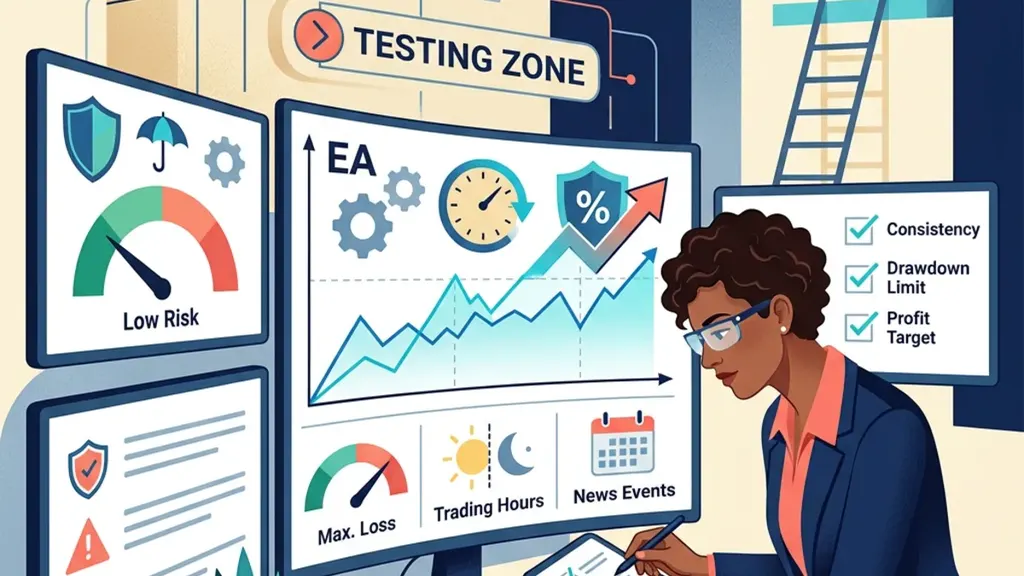
Establishing a rigid comparison protocol is essential when evaluating multiple automated systems. Define a set of criteria before you start your testing. Examples include maximum drawdown, win rate, and profit factor. Use a standard deposit size for all systems. This allows you to compare their risk management performance directly. When you test everything under the same conditions, you remove the bias that comes from varying capital sizes. You also avoid bias from different market timing during the test period.
Use a spreadsheet to track the results of each EA daily. Log the number of trades, the total gain or loss, and the maximum peak-to-valley drawdown reached during the test. By observing how each system handles the same market movements, you can identify which ones align with your personal risk tolerance. If one system consistently hits your drawdown limits while another remains stable, the choice becomes clear, regardless of which one had the higher headline profit number.
Simulate firm loss limits
Simulate the rules of your target firm within your demo testing protocol. If the firm has a maximum daily loss limit, configure your monitoring software to halt trading if that limit is approached. This shows you whether the EA is capable of self-regulation. You will see if it will continue to trade into a loss. Testing this behavior in a safe environment is vital. It reveals the system's true resilience without risking your actual funding status.
Keep your testing period long enough to encounter different market conditions, including quiet news-free days and volatile major announcements. An EA that performs well in a flat market might fall apart when the market enters a strong trend. Your protocol should force you to wait for a full cycle of performance data before you draw any conclusions. A patient, data-driven comparison will help you identify the best ea for prop firms that actually fits your specific requirements and risk appetite.
Keep a decision log and rejection criteria
Maintaining a decision log is a simple but powerful tool for any trader using automation. Every time you decide to adopt, modify, or reject a setting, write down the reason for that choice. For instance, if you decide to stop an EA because its drawdown exceeded 8%, record that limit. This practice prevents you from 'forgetting' why you previously rejected a specific system or strategy, helping you stay consistent with your risk management plan throughout your trading journey.
Define clear rejection criteria before you even begin researching. If a system requires a strategy that relies on martingale, or if it does not have an adjustable stop-loss function, reject it immediately. Don't waste time trying to make a flawed system work just because it looks good on a marketing page. Having a list of 'must-haves' and 'deal-breakers' allows you to quickly filter out unsuitable options and focus your energy on the systems that actually match your needs.
Log unexpected market behavior
Your log should also include notes on market events that caused the EA to behave in an unexpected way. If a major news release caused the EA to take an oversized position or fail to open a stop-loss, document this so you can improve your future configuration. This learning process is what turns a regular user into an expert. You want to build a cumulative knowledge base that helps you understand the strengths and weaknesses of the tools you use.
Regularly review your decision log to see if your risk management criteria need updating. As you gain more experience, your definition of an acceptable risk may evolve. However, ensure that any changes are made based on data and logic, not because you are chasing short-term gains. A professional trader treats their trading as a business, and a detailed log is an essential part of that business record, helping you stay disciplined and accountable over the long term.
Choose a tool you can monitor and stop
Even when using the best ea for prop firms, your role is to oversee the system, not to relinquish all control to it. You must ensure that you have the ability to manually override or stop the EA whenever necessary. If the system is a black box that hides its inner workings or lacks an emergency kill-switch, you should not trust it with your account. You need to be the final layer of defense against any unexpected market event or technical glitch.
Set up external monitoring alerts that inform you whenever the EA opens a position. Also set alerts for when a drawdown limit is triggered. You should not have to manually check your terminal every few minutes to see if the system is functioning. Reliable alerts allow you to step away from the screen. You can still maintain awareness of your account's health. This balance between automation and oversight is the key to maintaining a long-term, stable trading career.
Define manual intervention rules
Identify the specific conditions under which you will manually intervene. For example, if a major news announcement is about to cause extreme volatility, pause the system. Ensure you are ready to pause it if your EA is not equipped to handle such events. Do not rely on the EA to automatically detect every market danger. Having a pre-defined set of rules for manual intervention gives you the confidence to act quickly. Do this when things do not go according to plan.
Finally, practice your emergency procedures regularly. If your internet or VPS fails, know exactly what your next step is to protect your open positions. You should have a plan for how to close your trades manually if the EA becomes unresponsive. Being prepared for the worst-case scenario is a hallmark of a professional trader. When you choose a tool that you can easily monitor and control, you significantly reduce the risk of catastrophic account loss from unexpected technical failures.

Common questions
Can I use any EA on a funded prop firm account?
No. While many firms allow automation, you must ensure your chosen system adheres to all prohibited trading practices such as high-frequency scalping or latency arbitrage. Always verify the rules of your specific funding partner before deploying any software, as policies vary significantly. Relying on unofficial advice can lead to an account ban for violating the provider's specific terms. A responsible approach involves checking the current documentation and confirming that your strategy is permitted under their defined guidelines.
How do I know if an EA fits my risk management plan?
You must test the EA in a realistic environment that replicates your account's drawdown limits and risk constraints. A system that shows excellent backtested profit is useless if it violates your 5% daily loss limit during a volatile session. Use a practice account to observe the bot's behavior in real-time, focusing on how it manages total exposure and protective stops. If the EA consistently pushes the boundaries of your risk limits, it is not a suitable tool for your account.
What happens to my positions if the VPS goes offline?
This depends entirely on your EA's design. If your strategy relies on virtual stops calculated by the software, your positions may remain open without protection if the terminal disconnects. This is why you must prioritize systems that use server-side hard stop loss orders. Always verify that your broker receives and keeps your stop orders even when your platform is down. Testing this by disconnecting your VPS while a trade is active is a necessary step to ensure your account security.
Should I trust backtest results from the vendor?
You should treat vendor backtests as marketing material, not as evidence of future performance. Many vendors optimize their tests to show the best possible outcome by ignoring real-world costs like commissions, slippage, and wider spreads. You must perform your own independent testing using high-quality historical tick data. Verify how the strategy handles periods of high market volatility and ensure that your testing conditions include all relevant costs. Only after you have independently validated the results should you consider using the tool.
Can I use an EA on all stages of the funding program?
Most firms permit EAs on both challenge and funded stages, but you must strictly verify the rules of your specific provider first. Some firms restrict certain types of strategies, such as those exploiting latency or using high-frequency methods. Always check the official documentation for any forbidden trading practices, as breaking these rules can lead to immediate account termination regardless of the profit made. Never assume that the software itself is approved just because the platform supports it.
How do I calculate if an EA meets my daily drawdown limit?
To calculate this, you must determine the maximum risk per position and the number of simultaneous trades the EA is allowed to open. Multiply the total risk per trade by the maximum number of concurrent positions to see the worst-case potential loss. Ensure this value is well below your firm’s daily loss threshold, leaving a buffer for slippage. If the EA does not have an adjustable stop-loss, it is likely unsuitable for a account with strict daily rules.
What is the best way to handle news events with an EA?
The safest approach is to either disable the EA entirely during major news events or utilize an news-filter setting if the system includes one. High volatility can trigger stop-losses at prices significantly worse than you anticipated, potentially causing a violation of your account's drawdown limit. If the EA lacks an automatic filter, you must manually monitor the economic calendar and pause trading before the high-impact announcements occur. Never risk your account during extreme market uncertainty.
Should I modify an EA's settings if it starts losing?
Do not rush to modify settings during a temporary losing streak, as this is often just part of the strategy’s normal statistical variance. If you change the settings every time the system has a bad day, you are essentially over-optimizing the EA to past events. Only modify settings if you identify a fundamental error in the code or if the market regime has shifted permanently. Always test any changes on a demo account before applying them to your funded account.