Prop Firms That Allow EAs
Updated
A list of prop firms that allow EA trading is only useful if it identifies the product and its conditions. Permission can depend on the platform, account size, strategy and account stage. An EA-friendly label beside a firm's name doesn't tell you whether your exact robot is permitted. It also doesn't tell you whether the robot can operate within the loss model. Those are separate checks, and both need an answer before you pay for an evaluation.
When comparing prop firms that allow EA use, start with the official account rules rather than a logo grid. This guide shows how to turn those rules into a practical shortlist. It includes specific FTMO and FundedNext examples, explains why some tools count as automation even without opening trades, and gives you questions to ask support. A documented answer for the account you're considering is more useful than a blanket promise that an EA works everywhere.
EA permission checks
| Strategy Characteristic | Key Operational Requirement | Compliance Focus |
|---|---|---|
| Trend Following | News event filtering logic | Avoidance of restricted volatility windows |
| Trade-Management Utility | Manual entry with script-based exit | Monitoring of order-flow update frequency |
| Mean Reversion | Volume and frequency thresholds | Prevention of liquidity disruption flags |
| Hybrid Model | Automated signal with manual execution | Consistency in risk per trade parameters |
| Scalping | Latency sensitive order management | Strict adherence to maximum transaction limits |
EA permission is more than a yes or no
When you search for prop firms that allow ea, you often find that a simple binary answer is misleading. Many providers permit automation but place strict boundaries on the types of execution allowed. It is not enough to confirm that a broker terminal supports algorithmic trading. You must dig into the specific terms of service to understand how they define permitted versus prohibited behavior. For example, some firms might allow trend following bots while banning high-frequency scalpers that rely on micro-latency. Always look for official documentation that outlines exactly which trading methods are acceptable for the specific evaluation stage you are entering. Check the FTMO EA guide for account-specific trading rules. For a wider product overview, read the prop firm EA review.
A common mistake is assuming that because a firm allows expert advisors, any strategy is automatically safe. Different providers interpret the concept of a fair trading environment in unique ways. Some may ban specific market-making styles that capture arbitrage, even if your bot uses an ordinary retail strategy. You must distinguish between technical feasibility and regulatory compliance. Just because you can upload your file to the platform does not mean your account won't be flagged for a violation later. Take the time to request written clarification if the terms remain vague regarding your specific trading style or technical setup. Compare the best EA for prop firms using evidence and account fit.
Check liquidity provider policy alignment
Consider a hypothetical scenario where you apply an automated mean reversion system. You might see consistent profits in backtests, but the firm's policy might flag the high number of trades as disruptive to their liquidity providers. This is where the gap between technical possibility and operational permission becomes clear. You need to identify whether your chosen automation setup aligns with the provider’s core business model. If your trading volume is high, investigate whether the firm has a maximum transaction limit per day. Failing to align your strategy with these institutional preferences often leads to sudden account disqualification during a payout.
Your goal is to build a robust framework that respects these institutional constraints from day one. Instead of hunting for prop firms that allow ea that appear permissive on the surface, prioritize firms that offer granular rule definitions. If a provider cannot explain what constitutes forbidden trading practice, you should view that as a significant operational risk. Use your initial preparation phase to map out the provider’s specific rules against your EA’s logic. By doing this upfront, you avoid building a trading system on a foundation that the provider may label as non-compliant, protecting your capital and your time investment.
Match the platform, product and account size
Matching your automation needs to the right platform is critical when using prop firms that allow ea. Not every provider offers the same level of API access or terminal stability for automated systems. For instance, some firms restrict EA usage to MT4 while others might support MT5 or custom proprietary platforms. If your software relies on specific indicators only available in MT5, you cannot simply switch to a firm that only supports MT4 without re-coding. Always verify the platform compatibility before you pay your evaluation fee to ensure your technical requirements are met without expensive workarounds.
Account size significantly dictates your available options. Some providers implement tier-based restrictions where larger capital allocations are limited to manual trading only. This is a common hurdle for traders moving from small evaluation accounts to high-value funded tiers. You must ensure your automation can scale down if you are forced to manage an account manually due to a size-based restriction. If your strategy relies on complex risk-management modules that only function in an automated mode, you may face a situation where you cannot safely operate your preferred account size.
Scale account models for compliance
Consider a worked example where a provider permits EA usage for accounts up to 50,000 but requires manual intervention for anything larger. If you scale your account through successful trading, your automated system might suddenly violate the terms of the larger account. Develop a contingency plan that allows you to shift to a hybrid model where the EA provides signals while you execute trades manually. Alternatively, verify if the firm offers specific product types that maintain automated permissions across all account sizes. This preparation helps you avoid future disruption or compliance issues during your growth.
Platform performance is another layer to consider. Algorithmic strategies often depend on execution speed, and different providers offer varied connection qualities to their liquidity pools. If your bot needs low-latency execution, test the demo environment of the target firm thoroughly. You want to see how the platform handles your specific order flow during high-volatility events. If you notice persistent slippage that wasn't present in your backtests, you may need to adjust your stop-loss buffers. Matching your system’s requirements to the provider’s infrastructure is just as important as reading the technical rules regarding permitted software usage.
Reading official policies without guessing
Interpreting the rules of prop firms that allow ea requires a critical eye and a focus on objective facts. Avoid relying on unofficial forums or social media commentary to understand a provider's stance on automation. These sources often contain outdated information or misconceptions about how risk management policies are enforced. Your primary source of truth must always be the official FAQ and the current terms of service provided by the firm. If you find a policy that is ambiguous, reach out to the support desk and ask for a clear, written response regarding your specific situation.
Look for specific clauses related to automated trading in the provider documents. These sections detail prohibited behaviors, such as grid trading with excessive leverage or high-frequency arbitrage. Even if a firm claims to be EA-friendly, hidden clauses regarding news events or holding periods could invalidate your automated trades. Archive the exact text of the rules at the time you sign up to create a baseline for your compliance records. This is vital if a firm later changes its policies. You may need to demonstrate your historical adherence to terms.
Review rules for prohibited trading
Take a systematic approach to reading the fine print. Divide the policy into sections like order execution, risk management, and platform constraints. Write down what is permitted and what is strictly forbidden. If a firm states that they allow EAs but restrict news trading, ensure your bot has a reliable news-filtering feature. Failing to account for these specific restrictions can result in your account being flagged or closed. This can happen even if your strategy is profitable and aligns with the general trading objectives.
It is also wise to understand how the firm manages their risk. When you use an automated system, you are essentially plugging into their risk management ecosystem. If your EA creates unintended risk patterns, the firm’s automated compliance tools might trigger a warning on your account. Understanding the logic behind their risk floors and trailing drawdowns helps you set internal limits for your EA. This ensures that your automation stops trading long before you hit a firm-level threshold, allowing you to maintain control and stay within the established rules for your account.

FTMO permission and strategy restrictions
FTMO is a well-known example of a provider that offers clear, documented guidelines for using automated systems. Their FAQ explicitly permits the use of expert advisors, provided the strategy adheres to their established risk management and trading objectives. This means you must operate within their rules regarding maximum daily loss and overall drawdown. You should never assume that FTMO’s permission for EAs is a blanket endorsement of any specific strategy. Instead, it is an environment where you are expected to apply your own robust risk management to prevent account violations that can occur with poorly tuned algorithms.
One important area to focus on is the specific restrictions surrounding news events. FTMO often advises caution or limits execution on certain instruments during high-volatility news releases. If you are using an EA, it must have the intelligence to detect these events and adjust its trading accordingly. If your bot continues to place orders during restricted periods, you risk violating the firm's trading guidelines. Always configure your EA to respect these news-based prohibitions, as they are a fundamental part of the firm's efforts to maintain market stability and fair competition among all their traders.
Verify drawdown calculation methods
The firm also differentiates between different types of trading products. For example, a 1-Step account might have a different daily equity floor calculation compared to a 2-Step model. Your EA needs to be aware of these differences to manage risk effectively. If your bot’s internal logic for calculating drawdown does not match the firm’s official method, you may face unexpected losses. Use hypothetical arithmetic to calculate your bot’s behavior against the specific limits of your chosen product. This ensures that you aren't surprised by a violation when your equity hits the firm’s defined thresholds.
Managing your EA within FTMO’s framework requires constant vigilance regarding trade consistency. The firm may track your best trading days and compare them against your cumulative profit. If your bot generates the vast majority of its returns in a single day, it might trigger a consistency check. You should design your strategy to produce a smooth, consistent equity curve rather than relying on occasional large spikes in profit. By aligning your EA's performance pattern with these expectations, you increase your chances of meeting the evaluation criteria and maintaining your funded status over the long term.
FundedNext platform and account-size restrictions
FundedNext represents another example of why you must read the terms for prop firms that allow ea with extreme care. Their policies include specific limitations based on account size and trading style that are quite different from other providers. For example, there may be caps on the account value for which EA usage is permitted. If you plan to scale your business, you must be aware of these thresholds well in advance. Attempting to run automated software on a capital tier that forbids it can lead to immediate account termination, regardless of your past success or total profit.
Their approach to different platforms also requires close attention. While they might support EA usage on MT4 or MT5, other platforms like cTrader could have entirely different rules. You cannot assume that because you are using an automation tool, it is globally compatible across the firm's suite of offerings. Verify the specific platform requirements for your chosen account type before you start your evaluation. This avoids the frustration of realizing your favorite trading bot is incompatible with the platform required for the account size you have selected to pursue.
Avoid prohibited automated tools
Another critical restriction often involves the use of third-party bots marketed as guaranteed pass solutions. These tools are frequently flagged and prohibited because they do not reflect a trader genuine skills. If you use a pre-bought automated system, ensure it does not fall under the category of restricted or prohibited software. Using such tools to bypass evaluation stages is a common reason for account closures. You should always opt for your own, independently verified strategies to demonstrate your skill. You will maintain your standing within the program rules this way.
Furthermore, their specific EA usage fees or conditions for certain account tiers are important to monitor. Some firms add an operational fee for those using automation to cover the increased server load. If you are researching prop firms that allow ea, factor these costs into your overall economic model. A strategy that is profitable in a backtest might lose its edge once you subtract these additional costs from your net returns. Always perform a complete cost-benefit analysis before committing your time and funds to a provider that requires specific operational conditions for automation.
Why a permitted EA may still be unsuitable
Even when you have identified prop firms that allow ea, you must remain cautious. An EA can be technically permitted by the rules but completely unsuitable for your risk management style. Many traders make the mistake of assuming that if a bot can legally run on a server, it is automatically a safe or profitable choice. This ignores the reality of market conditions. A strategy that works well in quiet markets might completely break down during a flash crash, leading to a rapid violation of your drawdown limits and the loss of your funded account.
Think about the impact of spread widening during the Asian session. Many automated systems are designed to capture small profits, assuming a certain level of transaction cost. If the broker’s environment has wider spreads than your bot assumes, the cumulative impact on your profitability can be severe. Even if the firm allows the bot, the strategy might simply become unsustainable as the cost of trading erodes your edge. You need to verify whether your EA has built-in logic to detect and pause trading when transaction costs exceed a specific, acceptable threshold for your capital.
Configure failsafe exit mechanisms
Operational failure is another risk that is often overlooked. A bot that loses its internet connection or encounters a bug in its code during a critical trade might leave you with an open position that you cannot manage. If your EA is not designed with a 'failsafe' mode that can flatten all positions, you are leaving your account exposed to unlimited risk until you can manually intervene. Always ensure your setup includes independent alerts and a secondary way to access your trading platform, such as a remote mobile device, to handle emergencies effectively.
The complexity of the strategy itself can be a liability. A bot with hundreds of adjustable parameters is prone to over-optimization, meaning it is tuned perfectly for the past but fails to adapt to future market changes. If you don't fully understand how each input affects the logic, you won't be able to troubleshoot when the strategy starts to underperform. Prioritize simpler, more transparent strategies that you can explain in a few steps. This helps you monitor the bot’s performance and make informed decisions about when to pause it before it turns a temporary drawdown into a permanent account failure.

Turn vague rules into a permission checklist
To navigate the policies of prop firms that allow ea, create a personal checklist that turns vague rules into actionable items. List the critical requirements mentioned in the provider documents, such as news trading rules, maximum position sizes, and allowed platforms. Next to each item, add your own internal constraints, such as your maximum acceptable slippage or the times of day you allow the bot to be active. This checklist acts as your roadmap. It ensures that you never miss a compliance requirement while focused on your trading strategy.
Include a specific section for platform-side checks. Record the version of the platform you are using, the latency you experience, and the frequency with which you audit your EA performance. For example, if the firm requires a specific stop-loss distance for certain symbols, make that a mandatory item on your checklist. Each time you deploy a new version of your strategy or update your bot, check it against this list. This proactive step helps you ensure that you are still operating within the boundaries. You will avoid technical errors that can lead to involuntary account closure.
Maintain regular compliance logging
Your checklist should also account for the human element of oversight. Even if the system is automated, you are responsible for its performance and compliance. Set a weekly schedule for reviewing your trade logs, checking for any execution errors, and ensuring that your bot remains aligned with the firm latest policy updates. By treating your automation setup as a professional business process rather than a set and forget tool, you significantly improve your chances of success. It changes your focus from hoping for a pass to actively managing a professional trading operation.
Finally, include a section for troubleshooting and emergency response. If your internet connection fails or the platform reports an error, what are the exact steps you will take? Write them down clearly. This might include steps like restarting the platform, verifying the status of open orders, or manually closing positions if the bot fails to do so. Having a predefined, written plan ensures that you remain calm and composed during high-pressure situations. Using this checklist consistently will help you maintain your eligibility with prop firms that allow ea while protecting your account from avoidable mistakes.
Distinguish robots from trade-management utilities
In the context of prop firms that allow ea, it is crucial to understand the difference between a trading robot and a trade-management utility. A trading robot typically makes entry and exit decisions based on its own internal logic, which is the type of automation that is often heavily scrutinized by firms. Conversely, a trade-management utility might simply help you manage your manual trades by automatically placing stop-losses or trailing them as profit increases. These utilities are often viewed more favorably, but even then, you must be careful not to trigger any unintended compliance issues.
A utility that manages your risk by adjusting orders can be a powerful tool for consistency. For instance, if you enter a trade manually but use a script to ensure your risk never exceeds 1% of your capital, you are demonstrating professional risk control. This is usually welcomed by firms that prioritize disciplined trading behavior. However, ensure that your utility does not perform functions that the firm might interpret as automated order-flow manipulation. Always check if the firm's rules allow scripts that interact with existing order types, as this can change depending on the specific provider.
Clarify utility software permissions
If you are unsure whether your tool counts as a prohibited bot or a permitted utility, describe its function to the support desk. Send them a clear, simple explanation of exactly what the software does. For example, clarify that the tool only manages stops and take-profits on orders initiated by the trader, and does not open new positions itself. Getting this clarification in writing is a smart way to protect yourself. It prevents any ambiguity if a risk management bot later flags your account for suspected automation violations due to the sheer speed of order adjustments.
Always keep in mind that the firm’s compliance engine may not know the difference between a bot and a utility. They see a rapid stream of order updates coming from a software-driven process. Therefore, even if your tool is just a helpful utility, it should behave in a way that is easily understandable. Keep your update frequency low and avoid creating patterns that look like algorithmic latency exploitation. By keeping your automation tools simple, transparent, and respectful of the firm's infrastructure, you minimize the risk of being misunderstood by the systems that monitor your account for compliance.
Third-party software and shared strategies
Using third-party software or shared strategies from external vendors is a common area of concern when working with prop firms that allow ea. Many traders look for pre-built strategies to jump-start their success, but these tools often carry hidden risks. A strategy developed by someone else might be over-optimized for a specific market regime that no longer exists, or it might rely on techniques that the firm strictly prohibits. Conduct your own due diligence on any third-party code before deploying it to your account, just as you would with your own custom algorithms.
If you decide to use an off-the-shelf strategy, you must first verify that it doesn't fall into the category of 'copy trading' or 'identical strategy' usage. Some firms place strict limits on how many traders can use the same strategy to prevent market manipulation or to manage their own risk exposure. If your account is found to be part of a large cluster of identical, automated accounts, you may be disqualified. Always prioritize building or customizing your own strategy so that it is unique to your trading account and aligns with your personal risk tolerance.
Validate third-party code transparency
You should also be aware that vendor support for third-party software is often lacking when it comes to compliance with specific prop firm rules. If a strategy update causes a policy violation, the vendor is unlikely to take any responsibility for your lost account. This is why you must understand every single line of the code you are running. If you cannot explain why the strategy is taking a trade or how it calculates its stop-loss, you are not truly in control. This lack of transparency is a major factor in why many traders fail during the evaluation stages.
Finally, ensure that any external tool you use does not violate the intellectual property or usage terms of the firm. Some platforms have specific requirements for software that interacts with their terminals, and using unauthorized third-party tools can be a reason for account termination. Always check the firm's list of approved or prohibited software vendors. If you are ever in doubt, the best path is to build your own tools or stick to manual trading until you can develop a custom solution that you fully understand and trust within the context of your specific firm's rules.

News, holding periods and instrument limits
Trading news events creates significant challenges for automated systems. When you use prop firms that allow ea, you must confirm if the provider enforces specific prohibitions on trading during high-impact releases. Some firms require that you close all positions a specific number of minutes before and after the release of major economic data. If your software ignores these timing rules, you risk an automatic disqualification. Always check the provider official documentation regarding news trading to see if it applies to your specific account tier or funding level.
Instrument limitations often accompany news restrictions in modern evaluation programs. You might find that the firm restricts specific currency pairs or indices during volatile market conditions. Even when your software is technically capable of handling these assets, the firm's server-side logic might flag your trades as violations. It is common for firms to categorize certain trading activities as forbidden during specific window periods. Before you deploy any logic, verify whether your chosen instruments remain available for automated trading throughout the entire trading day without interruption.
Monitor session exit requirements
Holding periods represent another critical constraint for automated traders to monitor carefully. Certain programs specify that all trades must be closed by the end of the day or before the weekend break. If your EA carries open positions into the weekend, you could trigger a breach of your contractual obligations. You must configure your software to recognize these time-based exit requirements. Failure to align your automated strategy with the platform's session rules can result in unexpected account closure, regardless of the system's actual profitability or performance.
Consider a scenario where your strategy holds a position during a major central bank announcement. If the firm's rules prohibit news trading, your account is at immediate risk. You should implement a hard filter in your EA that checks for news events in real time. If an event is upcoming, the system should halt all new orders to ensure you stay within the defined compliance boundaries. By proactively managing these timing constraints, you protect your capital and maintain your standing with the provider throughout your trading career.
Compare loss models rather than headline funding
Headline funding numbers often distract from the more important mechanics of loss models. When searching for prop firms that allow ea, the structure of the drawdown limit is the most critical factor to assess. You need to distinguish between fixed, trailing, and intraday drawdown models. A trailing drawdown that follows your peak balance is significantly more difficult to manage with automated systems that tend to have high variance. Always calculate how your strategy's worst-case drawdown fits within the specific rules of the funding program.
Fixed loss models provide better predictability for automated strategies over the long term. Your risk remains defined by your starting balance under a fixed model. This makes it easier to set consistent risk parameters in your software. If you use a trailing model, your maximum allowable loss shrinks as your equity fluctuates. This shift can trigger an accidental breach. You must ensure that your EA risk management logic is sensitive to the type of drawdown model you are operating under at all times.
Track real-time equity thresholds
Intraday equity floors require careful monitoring to ensure your software does not exceed the allowed daily loss. Many firms track the difference between your previous day's closing balance and your current equity. If your EA executes a high volume of trades, the aggregate loss can easily hit these limits during a single session. Always assume that the firm tracks your equity on a real-time basis. Configure your system to stop trading once you reach a predefined percentage of your daily allowance to avoid violations.
For a worked example, assume an account with a 5% daily drawdown limit on a $100,000 balance. If your strategy loses $4,000 in a morning session, you must stop immediately. Relying on your system to make a profit in the afternoon is a major risk that often leads to account failure. By setting a hard stop at $3,500 within your EA, you maintain a safety buffer that keeps you compliant. Always prioritize capital preservation over the attempt to recover losses on the same day.
Ask support useful product-specific questions
Generic inquiries to support desks rarely provide the level of detail needed for professional automation. When you contact prop firms that allow ea, ask specific questions about their server architecture and policy enforcement. For instance, ask whether they have a dedicated feed for automated strategies or if there are specific latency requirements for software users. You should also inquire if they differentiate between proprietary and third-party expert advisors. The quality of the response will indicate how much the firm truly understands the technical needs of automated traders.
Request clarification on how they handle duplicate orders or connection failures during high volatility. You need to know if the firm's server automatically rejects orders that arrive with high latency. If you use a strategy that requires rapid execution, this information is vital for your success. Documenting the answers you receive from support provides you with a paper trail in case a policy dispute arises later. Always request these answers via email so you have a written record to reference during your evaluation.
Query firm-specific trade limits
Ask about the specific limitations regarding the number of concurrent open positions or pending orders. Some providers apply soft limits that are not always listed in their public terms of service. If your EA frequently opens multiple grid levels, you need to be aware of these caps. Knowing the maximum number of concurrent orders allowed helps you adjust your position sizing logic to avoid hitting hidden walls that could stall your strategy. Always keep your support correspondence organized by firm and date.
Suppose you plan to run a scalping system that opens 20 positions per day. Asking support if this frequency triggers any automated risk filters is a prudent step. If they mention that high order volume is reviewed manually, you should be prepared to explain your strategy. This type of due diligence helps you avoid unnecessary account scrutiny. By asking the right questions, you demonstrate that you are a serious participant who respects the firm's platform stability and overall risk management framework.

Assess execution conditions on demo
Testing on a demo account is non-negotiable before committing capital to an evaluation. When testing prop firms that allow ea, use a demo environment to evaluate the speed of execution and the prevalence of slippage. You should notice how the platform handles your specific order types during periods of market stress. If your EA relies on tight stop-losses, you need to confirm that these orders are filled within acceptable ranges. A demo session provides the only reliable evidence of how the platform interacts with your code.
Use your demo account to stress-test the interaction between your software and the provider's server. Run simulations where you intentionally trigger connection failures to see how the EA recovers. Does it automatically re-sync with the server or does it leave dangling orders? This is a crucial test of your software's robustness. If the system fails to manage open trades effectively during a simulated network outage, you should not move to a real account until you fix the underlying logic errors.
Analyze demo account slippage costs
Compare the execution quality of your demo account with your historical backtests. If you notice a significant discrepancy in fill prices, your strategy might not perform as expected in the evaluation. You need to calculate the difference in slippage costs and adjust your expected profit factors accordingly. This realistic assessment helps you avoid disappointment when you eventually trade on an evaluation account. Always keep detailed logs of every trade execution during these demo sessions to analyze your costs effectively.
Imagine your system triggers at a specific price level. If your demo logs show that orders are consistently filled 2 points away from your target, the strategy edge might be compromised. You should factor this slippage into your backtesting model to see if the strategy remains viable. Perform this analysis during the demo phase to gain confidence. You need to know that your system can handle the reality of the prop firm execution environment. Do not skip this critical validation step.
Track policy versions and account changes
Prop firm policies are not static and can change without significant warning. As you evaluate prop firms that allow ea, maintain a folder that contains the specific terms of service active at the time of your registration. When a provider updates their rules, archive the previous version and compare the changes. This practice is essential for long-term compliance. If you notice a shift in how they view automated trading, you must be prepared to adjust your strategy to remain within the new parameters.
Keep a log of all communications with the firm regarding your account status. If you are authorized to use a specific software, save the confirmation email in a secure location. If the firm later claims that your software is prohibited, you will have the necessary evidence to defend your position. Tracking these details is part of a professional approach to managing your evaluation progress. Always assume that the burden of proof for compliance rests on your shoulders, not on the provider.
Monitor for updated policy terms
Monitor your account dashboard regularly to check for any updates to your trading conditions or limitations. Sometimes, firms change their platform offerings or introduce new software restrictions for specific account types. If you are not vigilant, you could find your EA violating a rule that was recently introduced. Create a monthly checklist to review these details, ensuring that your strategy continues to operate within the current framework. Proactive management prevents many of the issues that lead to sudden account termination.
Think of a situation where you have successfully traded for 2 months under one set of rules, but the firm then alters their consistency policy. If you continue to trade as before without checking the new documentation, you could accidentally breach a regulation. You should update your EA parameters to align with the new requirements immediately. By maintaining a clear history of policy changes and your corresponding adjustments, you protect your capital and maintain your access to the evaluation program.
Build an evidence-based comparison shortlist
A shortlist of potential partners should be based on verifiable facts rather than marketing claims. When researching prop firms that allow ea, categorize them by their automation support and their specific rule structures. Look for firms that provide clear technical requirements for expert advisors. You should create a matrix comparing drawdown models, news policies, and platform availability. This method allows you to objectively evaluate which firm is the best fit for your specific trading style without being influenced by aggressive promotional materials.
Focus on the quality of evidence provided by other users and the firm's reputation for consistency. A firm that frequently changes its rules might be a poor partner for an automated trader who needs stability. Check community forums for discussions about how the firm handles automated account disputes. While you should not rely on anonymous feedback alone, it can highlight common issues that you should investigate further with the firm's support desk. Build your shortlist by filtering out providers that do not meet your baseline criteria.
Evaluate total operational costs
Evaluate the cost structure of each firm on your list to ensure the total expense remains manageable. Some firms charge extra fees for automated trading or require a specific platform that has its own costs. You should calculate the return on investment including these overheads. A cheap evaluation might become expensive if the firm's execution environment causes frequent losses due to high slippage. Always aim for a balance between reasonable entry costs and a robust platform that supports your chosen automation technology.
Let us say you are comparing 2 firms. One offers a lower evaluation fee but restricts the use of certain EA features, while the other charges a higher fee but provides full support for your software. You should model the cost-benefit of both. If the cheaper firm's restrictions force you to reduce your position size, your potential return might drop below the cost of the more expensive firm. By creating this evidence-based comparison, you make a decision based on performance rather than just the initial price tag.
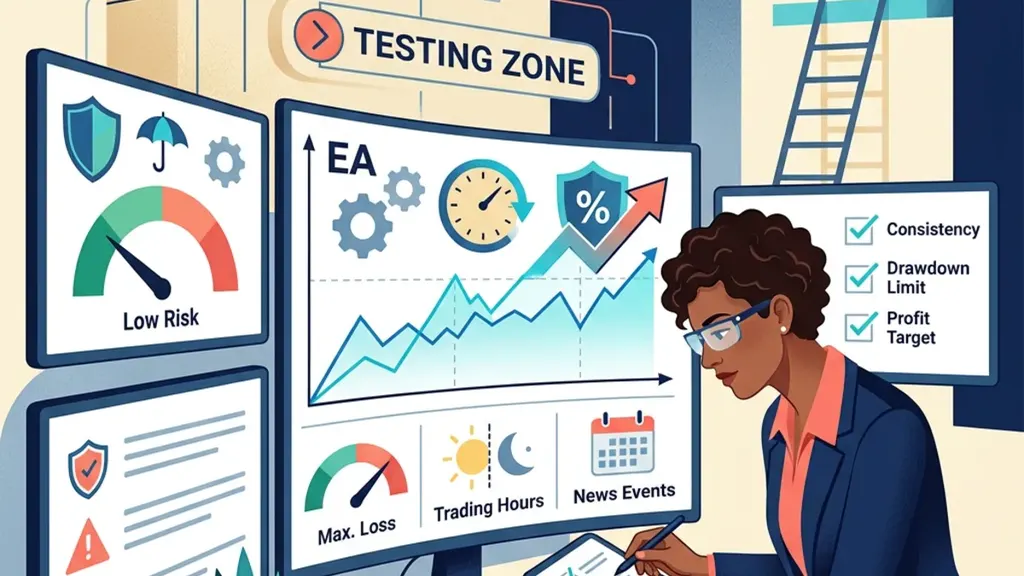
Plan the move between evaluation and funded stages
The transition from evaluation to a funded account is a major milestone that requires careful planning. Many traders fail here because they assume their strategy will work exactly the same way under real funding. When you use prop firms that allow ea, you must anticipate that the firm might switch you to a different server environment or change your execution parameters once you are funded. You should keep your setup as consistent as possible and monitor your performance during the first few days of the new stage.
During this transition, double-check that your software is still connected to the correct server. Sometimes, credentials change during the migration process, and a failure to update your settings can leave your account inactive. If your EA stops trading for a few days, you might violate inactivity rules that are often hidden in the fine print. Ensure that your automated system has a notification mechanism to alert you when orders fail to place or when the connection to the server is lost.
Recalibrate settings for funded accounts
Review your risk settings specifically for the new account environment. If your funded account has a larger capital base, your position sizing might need to be adjusted to stay within the drawdown limits. Do not simply copy your evaluation settings without performing a new calculation. This is a common mistake that leads to early breach on funded accounts. By taking the time to recalibrate your software for the new balance, you increase your chances of sustained success during your tenure as a funded trader.
Imagine you have passed your evaluation using a 0.1 lot size on a small account. If you are now funded on a larger account, your previous lot size might be too small, or your risk-per-trade might be too low relative to your new balance. Recalculate your lot sizing to match the new account's risk capacity. This step ensures that your strategy remains as effective as it was in the evaluation stage. Always prioritize steady growth over a sudden change in your trading strategy.
Common mistakes in EA-friendly firm lists
Many public lists of prop firms that allow ea are inaccurate and contain outdated information. A common mistake is assuming that a firm's support for a platform like MetaTrader automatically means all expert advisors are permitted. In reality, firms often restrict specific types of automated behavior, such as latency exploitation or high-frequency trading. You should always verify the list yourself by reading the current terms and contacting the provider directly. Do not rely on third-party websites to confirm whether your specific system is allowed.
Another error is failing to consider the firm's geographical restrictions or local market regulations. Some firms are only available in specific regions, and their rules regarding automated trading may vary based on your location. You must check the firm's eligibility requirements as they apply to your specific country. Relying on a list that ignores these nuances can lead to account rejection or problems with payouts. Always check the official website as the ultimate source of truth for your account eligibility.
Filter biased provider rankings
Avoid lists that rank firms based on subjective performance or profitability, as these are often biased or affiliate-driven. A firm that is perfect for one trader might be entirely unsuitable for your specific EA. Focus on finding a firm that offers the technical features you need, such as reliable execution and clear rules regarding automated systems. Your goal is to find a platform that provides a stable environment, not a firm that is currently hyped on social media. Build your own criteria for success.
Suppose a popular list labels a firm as the best for automation. If you investigate and find that the firm has a rule against hedging or specific indicators, your strategy might be disqualified. This is why you must perform your own verification. Never take a curated list as a guarantee that your EA will be accepted or that you will achieve profitability. Your focus should be on finding a compatible operating environment that aligns with your strategy's needs and risk management requirements.
Choose the account before choosing a preset
Choosing the right account type is a foundational step before you apply any specific software preset. When you select from prop firms that allow ea, the account's drawdown structure, news policy, and execution type should dictate your approach. If you choose an account with a strict intraday drawdown limit, your software must be configured with a conservative, low-frequency preset. Trying to force a high-frequency scalping preset onto an account with tight rules is a guaranteed way to fail, regardless of the quality of your code.
Align your account choice with your risk tolerance and available time for management. If you cannot monitor your account during key market hours, you should choose a product that allows for automated stops and has a looser news policy. A more restrictive account might be cheaper but will require constant manual oversight, which defeats the purpose of automation. Your account type should support your lifestyle and your technical capabilities. Always pick a structure that allows your strategy to operate without requiring constant intervention.
Test presets against account rules
Test your chosen preset on a demo version of the exact account type you plan to purchase. Different account tiers at the same firm might have different rules regarding automated trading or instrument access. If you find that your chosen preset frequently breaches the rules in your testing, you should either select a different account or modify your strategy. Do not wait until you have paid for an evaluation to discover that your setup is incompatible with the account's rules and limitations.
Consider an account with a high profit target and loose drawdown rules. This type of account might allow for a more aggressive preset, but it will still require you to manage your risk carefully. By choosing the account first, you create a framework for your automated system to thrive. If your goal is long-term growth, select a structure that provides a stable environment for your trading. This strategic approach helps you build a consistent record and increases your probability of reaching the funded stage.

Common questions
Can an EA guarantee a pass?
No. Market conditions, slippage, and rule interpretation make a guaranteed result impossible. Prop firms that allow ea do not promise that using software will lead to a pass. You must evaluate the EA's performance against the firm's strict drawdown and risk management rules. Always treat software as a tool, not a shortcut to success. Realistic execution assumptions are essential, as backtests often fail to account for the real-world costs and challenges of live trading within a funded program.
Does EA support mean every strategy is allowed?
No. Providers often restrict specific behaviors like latency arbitrage, grid trading, or high-frequency methods that might disrupt their market. Even when prop firms that allow ea technically support automation, they maintain the right to prohibit methods that violate their trading objectives. You must verify if your specific strategy, such as news-based or high-volume trading, is permitted by the firm's current rules. Always obtain written clarification from support if you are unsure whether your strategy falls into a restricted category.
Should I trade major news with an EA?
Check the provider's specific news trading policy first. Many prop firms that allow ea implement restrictions on news-based execution to prevent excessive slippage or market risk. Even if technically permitted, trading during news events can lead to catastrophic order fills that exceed your stop-loss limits. Assess the risk-to-reward ratio and whether your EA can accurately navigate high volatility. A strategy that is permitted by the rules may still be unsuitable for your capital preservation goals during major economic announcements.
Are demo results enough for validation?
No. Demo results do not guarantee future performance, and execution conditions often differ from live environments. When researching prop firms that allow ea, use demo tests to evaluate your software's technical stability, not just its profit potential. Check if your EA handles slippage, disconnects, and order management correctly under real-time stress. Treat demo testing as a process to refine your operating procedures and ensure compliance, rather than a proof of profitability that ensures success in a live-funded account environment.
Can I use multiple EAs on the same account?
Most firms allow multiple EAs as long as the combined activity does not violate any rules regarding total position size, order volume, or risk limits. However, you must ensure that your different systems do not conflict with each other by opening correlated positions that lead to excessive exposure. Always check the firm's specific policy on concurrent automation and test your combined strategy on a demo account to observe how the firm's server handles the increased order flow.
Does EA usage require a specific VPS provider?
No, firms generally do not require a specific VPS provider, but you must ensure your chosen VPS has low latency to the firm's server. A slow connection can lead to high slippage and poor execution, which can degrade your strategy's performance significantly. You should choose a VPS located in the same data center region as the firm's server to minimize delays. Always test your system's connection speed using a ping test during your demo phase to verify it meets your needs.
What if my EA strategy uses a hedge?
Hedging is often restricted or prohibited by many prop firms, even if they generally allow expert advisors. If your strategy relies on hedging to manage risk, you must verify the firm's specific rules on this practice before you begin. Opening opposite positions on the same pair can be flagged as a violation, leading to account closure. Always read the terms of service regarding position management and contact support to clarify their definition of prohibited hedging practices in your specific account.
Can I modify a preset to fit a firm's rules?
Yes, you can and should modify your presets to align with the firm's rules. If a firm restricts trading on specific news events or limits the number of open positions, you must adjust your EA settings accordingly to stay within compliance. Do not attempt to hide these modifications or use hidden settings to bypass rules. Transparently configuring your software to respect the provider's constraints is a sign of a professional approach and is necessary for maintaining your eligibility for funding.