Understanding Prop Firm Consistency Rules
Updated
A prop firm consistency rule usually measures how concentrated your profit is, but the calculation isn't the same everywhere. The denominator might include losing days, exclude them or reset after a particular event. Those details can change the result even when the trade history is identical. Start by finding the exact definition for your account. Don't assume that a percentage quoted in a comparison article tells you how the firm will calculate it.
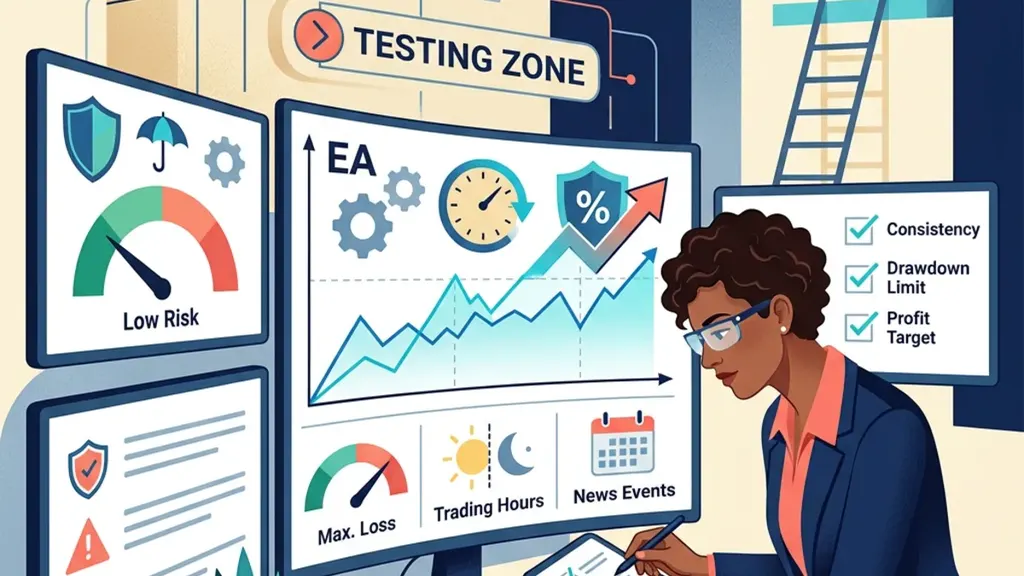
Before configuring an EA around a prop firm consistency rule, work through a few ordinary trading sequences by hand. Include a losing day, a partial close and a larger-than-usual winner. This guide explains the arithmetic, the difference between missing an eligibility condition and breaching an account rule, and the effect on daily routines. It includes the current and legacy FTMO examples where relevant. The goal is to understand the metric without forcing extra trades just to make a dashboard look better.
Consistency rule calculations
| Strategy Approach | Risk Management Focus | Consistency Impact |
|---|---|---|
| High-Frequency Scalping | Multiple small stops | Prevents single-day concentration spikes |
| Trend Following | Wide stop-loss buffers | Risks exceeding max daily profit limits |
| News Event Trading | Aggressive position sizing | High probability of extreme ratio variance |
| Mean Reversion | Incremental profit taking | Supports steady, compliant equity growth |
| Swing Position Trading | Capital-weighted allocation | Requires careful management of carry-over gains |
What a consistency rule measures
A profit-consistency requirement acts as a structural guardrail designed to prevent sudden, outlier gains from dominating your overall performance. These rules serve to ensure your trading style remains steady rather than relying on high-stakes gambles that lack repeatability. You should view these metrics as a way for the provider to verify that your capital management stays within predictable bands. When you look at these requirements, understand that they are not arbitrary burdens but rather standardized checks on risk. Measuring your performance this way keeps the focus on steady growth through disciplined, consistent execution over time. Check the FTMO EA guide for account-specific trading rules. For a wider product overview, read the prop firm EA review.
To properly monitor your progress, focus on the relationship between your single best day and your total net profit. A prop firm consistency rule often sets a percentage cap, such as 50%, on how much one day can contribute to your overall gains. If you make $10,000 total but your best day accounts for $6,000, you might breach this limit. You need to verify if the calculation uses realized gains or unrealized equity. By tracking this ratio daily, you identify potential conflicts before they trigger a compliance flag on your account.
Monitor impact of outliers
Scenario testing helps clarify how these rules affect your daily routine. Imagine you have a successful streak where you gain $500 each day for 10 days. If you suddenly pull in $4,000 on day 11, the proportional influence of that massive day changes your aggregate math instantly. You might find yourself locked out of a payout because the latest spike distorted your average. Always run these figures against your historical data to see if your strategy naturally produces these outliers. If it does, you must adjust your position sizing to align better.
Troubleshooting compliance issues requires granular data. Do not just look at your final balance. Instead, export your trade history into a spreadsheet to calculate your daily returns. Check if your platform treats weekend carry-over positions as separate daily entities or part of the previous session. This distinction matters because a prop firm consistency rule is often sensitive to how trades are categorized by date. If your automated software closes positions randomly, you may accidentally trigger a breach. Always keep a daily log of your profits to ensure your math matches the provider dashboard exactly every time.
Separate best-day rules from risk limits
Traders often confuse a profit-consistency requirement with standard risk management limits like maximum drawdown. While both aim to protect capital, they operate on entirely different mathematical foundations. A drawdown limit sets a hard floor on your equity to stop total losses. Conversely, a consistency requirement evaluates the quality of your success. You could theoretically be in a profitable state but still fail because your performance profile looks too volatile. Keeping these two concepts distinct in your mind is essential for avoiding accidental breaches while you manage your open positions.
Consider the tradeoff between high leverage and rule adherence. Many traders increase leverage to hit profit targets quickly. However, this often leads to a single oversized day that hits your consistency ceiling. You might gain 15% in a single session, which looks great but creates a difficult denominator for your consistency math. If you want to keep your account, you must manage your exposure so that no single winning session creates a mathematical impossibility for your future scaling. Lowering leverage is a common way to ensure you stay safely under the radar.
Protect account against concentrated wins
A worked example illustrates the risk here. Assume you have a target of $10,000 and a rule requiring that your best day cannot exceed 50% of total gains. If you reach $5,000 in a single move, your entire account performance is now tied to that specific win. If you then lose $1,000 over the next three days, your total profit drops to $4,000. Now your $5,000 best day is 125% of your total gain, which is a breach. This shows why over-aggressive trading ruins your account health.
Managing these tradeoffs requires careful planning of your daily exit strategy. When you approach your profit goals, consider trimming your position sizes. This prevents a lucky run from ballooning into a noncompliant state. The prop firm consistency rule effectively penalizes traders who rely on black swan events or extreme market spikes. By smoothing out your performance, you demonstrate that your results come from a reproducible edge. Focus on small, incremental wins that do not skew your overall statistics, and you will find it much easier to clear these regulatory hurdles effectively.
Read the numerator, denominator and account stage
To navigate a prop firm consistency rule, you must understand exactly which values fill your numerator and denominator. The numerator is typically your single most profitable closed day, while the denominator is your cumulative net profit. Some providers exclude commission fees, while others include them in the total calculation. If you do not know the exact definition your firm uses, you are essentially flying blind. Always check the official terms for the specific definition of net profit, as even minor variations in accounting can make or break your status.
Account stages often change the way these rules are applied. During a challenge phase, the rules might be more lenient, but the transition to a funded stage often introduces stricter monitoring. When you move to a live account, the internal controls are usually more rigid to protect the firm's capital. Do not assume that the math you used during a simulation will apply identically once you are funded. Check the specific account stage documentation to see if any secondary rules trigger only when you are managing real capital assets.
Control partial trade closes
Consider how partial closes affect your numbers. If you take profit on half a position, the system might book that gain immediately. This is different from waiting until the entire trade closes. If your trading software scales out of trades, your daily profit totals might fluctuate significantly throughout the day. This unpredictability is exactly what a profit-consistency requirement is designed to catch. If you cannot control when trades close, you might inadvertently spike your daily profit without realizing it, leading to an immediate breach of your current terms.
Practical documentation is your best defense here. Create a table that maps every trade to its specific realized profit for the day. If you notice your daily variance is high, look for ways to optimize your exit logic. Maybe you are holding too much volume through a news event, causing an oversized gain. By analyzing these sessions, you can identify exactly when your account is most vulnerable to a consistency error. Adjust your exit thresholds to ensure your daily gains stay within a tight, manageable range regardless of how the market moves.

Calculate a basic profit-concentration ratio
A profit-concentration ratio identifies how much of your wealth depends on your best trading sessions. If you calculate this as your best day divided by your total profit, you get a clear view of your risk profile. A prop firm consistency rule usually sets a threshold that you must not exceed. If your ratio is consistently above 0.5, you are arguably over-dependent on a single day. You need to redistribute your gains over more sessions to bring this number down into a safer range before you reach your goal.
To perform this calculation, take your current account balance and subtract the initial capital to find your cumulative profit. Next, isolate your single highest-profit day from your entire history. Divide the latter by the former to get your ratio. If your cumulative profit is $5,000 and your best day is $3,000, your ratio is 0.6. This is a red flag for many firms. You should look for ways to scale your position size down during highly volatile periods to prevent these sudden spikes from ruining your ratio.
Track ratio during losing days
How do losing days impact this? They are a double-edged sword. While losing days reduce your total cumulative profit, they also technically lower your denominator, which can make your best day look even larger by comparison. This is a common trap. If you have a few bad days, your profit-concentration ratio might spike overnight without you doing anything differently. This is why you must monitor your math daily. Do not wait until you are ready to withdraw funds to check your standing; you might already be in breach.
Strategy adjustment is the next logical step. If your ratio remains high, it means your strategy is too aggressive during peak momentum. Try tightening your profit targets or adding a dynamic volume cap during news sessions. This doesn't mean you stop making money; it means you spread those gains out more evenly. By reducing the size of your peak wins, you stabilize your equity curve. This makes your account look more professional and keeps you comfortably within the limits of the profit-consistency requirement for longer periods.
How losing days change the calculation
Losing days significantly alter the math behind a prop firm consistency rule because they shrink your cumulative net profit. When your total profit falls, your best-day percentage increases if that best day remains the same. This can lead to a situation where a simple string of losses pushes you into a breach even if you have not made a single trade. This mathematical reality makes it vital to monitor your net profit closely. If you see your total balance trending down, you must be aware of how that shifts your consistency metrics.
Consider a scenario where you have a $4,000 total profit. Your best day was $2,000, resulting in a 50% ratio. If you then lose $1,000 over two days, your total profit drops to $3,000. Your best day is still $2,000, so your ratio is now 66%. You have just triggered a breach through simple subtraction, even without a new big win. This creates a dangerous feedback loop for struggling accounts that requires immediate, calculated action to rectify or stabilize.
Maintain a safety margin
You should plan for these scenarios by maintaining a buffer between your current ratio and the allowed maximum. Never trade right up to the line. If the limit is 50%, aim for a 35% to 40% ratio. This gives you room to absorb a few losing days without accidentally flipping into a breach. It is a proactive approach to risk management that keeps your account safe from the inherent volatility of the math involved in these rules. Always prioritize this buffer over chasing a higher payout.
Troubleshooting this issue requires you to view your account through the lens of a controller. If you hit a losing streak, do not try to recover it all in one large trade. That recovery attempt could create an even bigger best day, making your consistency problem worse. Instead, reset your risk parameters and trade smaller. A slow recovery keeps your best-day percentage stable while you work back to your profit goals. By resisting the urge to gamble on a single recovery trade, you protect your account from the common traps of consistency-based monitoring systems.
Understand FTMO current versus legacy examples
Prop firm rules are not static, and you must understand the distinction between legacy metrics and current requirements. Providers like FTMO update their policies periodically to account for new market realities. An old blog post or a three-year-old forum comment might suggest a calculation method that is no longer valid. When you evaluate your performance, rely only on the most recent documentation provided in the official dashboard. Using outdated information is a guaranteed way to misunderstand your compliance status, which can lead to unnecessary risk and potential account termination.
Legacy rules often used simpler calculations, such as the sum of all profitable days, which were easier to satisfy. Current versions of the prop firm consistency rule are much more sophisticated, often focusing on the ratio between the single best day and the total net profit. This shift reflects the industry move toward penalizing strategies that lack repeatability. You must align your testing with the current documentation to ensure your performance records are accurate. If your manual tracking doesn't match the dashboard, check for a recent policy update immediately.
Check rules for current account
How do you stay updated? Most firms provide changelogs or email notifications about rule updates. Make a habit of checking your account's specific rule page once a week. If you rely on third-party advice, verify that advice against the official text. Never assume that the rules you followed in a previous challenge will hold for your next account. Each order or product type might have unique constraints that change over time, so vigilance is your best tool for managing your account standing successfully.
Practical example: if you find an old guide saying your best day must be under 30%, but your dashboard shows a 50% limit, follow the dashboard. The dashboard represents the current server-side configuration of your account. Do not try to argue based on past records. Instead, configure your automated strategy to handle the strictest possible constraints currently in force. By playing it safe and assuming the most rigid interpretations, you build a resilient strategy that can survive even if the firm adjusts their rules again in the future.

Build an EA routine that respects the metric
Automated trading software needs to be coded with the profit-consistency requirement in mind. A typical EA is designed to chase profit, but if it doesn't know about your compliance thresholds, it can destroy your account in seconds. You need to implement custom logic that monitors your current profit-concentration ratio and adjusts position sizing automatically. If your ratio approaches a critical limit, the EA should throttle back or pause trading. This level of oversight ensures your automation stays within the rules without requiring constant human intervention during the day.
Consider integrating a daily equity floor within your EA logic. This keeps your bot from taking trades that could lead to a massive, non-compliant outlier. If your bot hits a predetermined profit target for the day, program it to stop taking new positions until the next session. This is a simple yet effective way to manage your consistency. It prevents the machine from accidentally over-performing on a day where market conditions are unusually favorable, which is often where consistency issues begin to creep in for many traders.
Reconcile orders during disconnects
You also need a fail-safe mechanism in your EA code. If the system experiences a connection drop, the bot should know exactly what to do upon reconnecting. Does it close all positions, or does it try to catch up? In a managed account, you want the bot to reconcile all open orders against the current server state before initiating any new ones. This prevents duplicate orders, which could double your risk and potentially lead to a massive, undesired profit spike that breaks your consistency metric entirely.
Finally, ensure your EA logs are detailed enough for your own review. A good log should track the profit of every single order and its daily impact. This lets you see if the bot is behaving as expected across different market regimes. If you find the bot is consistently pushing the limit on certain symbols, you might need to adjust your parameters. By building this internal intelligence into your EA, you transform it from a simple signal-follower into a risk-aware system that respects the rules of your funded account.
Avoid splitting orders to disguise exposure
A common mistake is trying to bypass a prop firm consistency rule by splitting a large trade into multiple smaller ones. This strategy is transparent to any sophisticated compliance monitor. If your system detects a pattern of many small orders designed to mimic a single, massive position, it may flag your account for forbidden trading practices. Do not attempt to manipulate or disguise your exposure. Instead, focus on legitimate trade management techniques that align with the spirit of the rules, as honesty is the only way to maintain a long-term professional relationship with your provider.
Why does splitting fail? Most modern trading platforms capture order flow metadata, not just the final result. If your EA executes 50 trades in one minute on the same symbol, the firm's analytics team will immediately see what you are doing. This looks exactly like an attempt to circumvent risk management protocols. A better approach is to use a consistent position size that reflects your overall risk budget. If you need to scale into a position, do it over hours or days, not seconds, and maintain a logical rationale for your entries.
Build a sustainable strategy
Consider the tradeoffs. By trying to game the system, you sacrifice your reputation for a short-term gain. If the firm flags you for manipulation, you may lose your capital and your access entirely. This is never worth the risk. Instead, focus on building a robust strategy that doesn't rely on these gimmicks. A truly scalable strategy should not require obfuscation. If you feel the need to hide your trades, your strategy is likely fundamentally flawed or too risky for the environment you are currently trading in.
The best way to handle large positions is to acknowledge them and manage the associated risk. If you are authorized to trade a specific size, just do it. If the size is too large for your consistency ratio, then you must accept that you cannot trade at that volume. It is far better to trade small and keep your account than to trade big and get banned. Focus on building a consistent, documented track record of honest, high-quality trading decisions. This will serve you much better in the long run than any attempt at clever manipulation.
Size trades from risk rather than a payout target
The fundamental error most traders make is sizing positions to hit a payout goal rather than sizing them to manage risk. When you focus on a target, you naturally take larger risks to get there faster, which leads to consistency issues. Instead, size every trade based on the amount you are willing to lose if the market moves against you. This approach aligns with the core requirements of a prop firm consistency rule. By prioritizing loss management, your profits will naturally follow, often at a more stable and compliant rate over time.
Work backward from your total loss limit. If you have a 5% daily loss cap, never risk more than 1% on a single trade or setup. This allows for a sequence of losses without hitting the catastrophic exit threshold. When your risk is small, your profit swings are also naturally contained. This is the hallmark of a professional trader. By limiting your exposure per trade, you automatically stay away from the volatility spikes that trigger consistency breaches, creating a much smoother equity curve for your account.
Size positions based on risk
Let us look at a practical, worked example. Suppose you have a $20,000 account and want to limit your risk to $100 per trade. With a 50 point stop loss, you are essentially trading $2 per point. This is a very safe, manageable size. Now, imagine if you were aiming for a $2,000 payout in one day. You might be tempted to trade $20 per point, which would blow your risk budget in just one trade. Always prioritize the $2 position size to remain consistent.
A final piece of advice: do not be afraid of a slow climb. Most funded programs do not have an expiration date for your performance. You have plenty of time to build your profit incrementally. The pressure to earn quickly is your worst enemy. If you treat your account as a long-term business, you will naturally adopt a conservative sizing strategy that keeps you within the profit-consistency requirement at all times. This discipline is what ultimately separates successful traders from those who fail because they chased an unrealistic, rapid payout.

Manage correlated winners across symbols
Managing multiple positions requires deep awareness of how a prop firm consistency rule impacts your total exposure. If you trade 3 correlated pairs simultaneously, a sudden market shift might trigger stop losses across all of them at once. This creates a large negative day that distorts your profit ratios. You must calculate the combined risk of all open trades to ensure you do not inadvertently violate the rules. If your firm flags high-concentration days, you need a system to spread entries across different time zones or non-correlated currency pairs to keep your daily performance metrics stable.
Scenario testing helps identify hidden correlations that common backtesting software often misses. For instance, holding long positions in EURUSD, GBPUSD, and AUDUSD during a dollar-positive news event typically results in a combined loss far exceeding your planned stop per trade. When you account for this, you realize that your position sizing needs to be reduced significantly. If your goal is to stay within a specific profit-consistency requirement limit, you should cap your aggregate risk per session. This practice prevents one major market movement from ruining your chances of meeting payout criteria.
Limit exposure across correlated symbols
Troubleshooting your correlation issue involves reviewing trade history logs during periods of high volatility. Check if your platform executes trades at nearly identical timestamps. If it does, you are essentially doubling down on one direction. To avoid this, modify your algorithm to stagger entry signals or implement a global limit on how many positions can be open on correlated instruments. If a specific symbol pair consistently triggers a breach, remove it from your trading universe entirely. Maintaining a diversified, low-correlation portfolio is the most effective way to protect your account's integrity.
Consider a worked example: you have a $100,000 account and a maximum 2% daily loss limit. If you trade 3 symbols with a 0.5% risk per trade, you risk 1.5% total. During a strong market rally, all 3 might hit stop losses simultaneously, causing a 1.5% drawdown in minutes. Because of the prop firm consistency rule, this large negative day forces you to earn significantly more in subsequent days to bring your average back up. By limiting total open risk to 1%, you effectively buffer your account against these massive, sudden drawdowns that often end evaluations.
Plan sessions without chasing a perfect score
Many traders mistakenly believe they must produce a steady, linear equity curve to satisfy the prop firm consistency rule. This obsession often leads to over-optimization and parameter curve fitting, which causes strategies to fail when market regimes change. Instead of targeting a perfect score, focus on creating a robust system that handles volatility gracefully. If you force trades to maintain a specific daily profit range, you end up taking sub-optimal entries that lead to unnecessary losses. Accept that some days will be naturally quieter than others while keeping your risk management logic strict.
A practical approach involves defining your operational session times clearly. If you trade only during the London-New York overlap, your activity remains predictable and easier to monitor. When you avoid trying to trade every market minute, you significantly reduce the risk of erratic, forced entries. This discipline helps you align with the profit-consistency requirement by preventing the kind of desperate, end-of-day trades meant to salvage a bad performance. Remember that the goal is long-term sustainability rather than achieving a perfectly flat line that looks good in a marketing screenshot.
Implement cooldown periods
Troubleshooting your session performance requires an honest review of your trade log at the end of each week. Identify days where you took excessive trades simply because you felt the need to make money. If those days show significantly lower average returns, they are likely dragging down your consistency stats. Modify your EA or manual routine to enter a 'cooldown' mode after a certain number of trades or after a specific daily loss limit is reached. This protects your account from impulsive behaviors that often lead to a rapid rule breach.
Worked example: Imagine you target $500 per day. One day you make $200 and the next you make $800. While the average is $500, a firm’s prop firm consistency rule might look at the variance between these days. If your trading is too volatile, the firm might penalize you. Instead of trying to force every day to hit exactly $500, focus on a risk-based approach where you limit your downside to $200 daily. By keeping the loss side tight, the natural variance in your winners becomes less of a threat to your evaluation success.
Build a spreadsheet or journal check
Keeping a detailed manual journal is essential for understanding your relationship with the prop firm consistency rule. While automated logs record the trade, a manual check forces you to review your decision-making process before and during the market session. Use a spreadsheet to track your daily net profit, your largest single trade, and the total percentage of gain compared to your account balance. This transparency allows you to see if you are approaching a threshold where your best day becomes too large relative to your total profits.
Your spreadsheet should include a 'Stress Test' column where you manually recalculate your stats if you lose a specific amount of money on a bad day. This helps you visualize how the profit-consistency requirement reacts to a losing streak. If your current strategy relies heavily on a few outlier winners, the math will quickly show that you are at high risk of a breach. Use this data to adjust your position sizing so that your winners and losers are more evenly distributed throughout your trading month.
Compare actual results with backtests
Troubleshooting with your data involves comparing your actual account growth against your theoretical backtest results. If the discrepancy is large, your strategy may be struggling with real-world slippage or execution latency. If your journal reveals that your gains only occur during specific news events, you need to be extremely careful. Many firms restrict trading during high-impact news, meaning your strategy might be inherently incompatible with their rules. Adjust your journal to flag every trade made within 5 minutes of a major economic announcement to monitor exposure.
Worked example: If your total profit is $5,000 and your best day is $3,000, your concentration is 60%. If the prop firm consistency rule demands that no single day represents more than 50% of your total profit, you are currently in breach. To fix this, you must stop trading once your best day hits $2,500. By tracking this daily in a spreadsheet, you can see exactly when to stop trading to avoid disqualification. This level of oversight turns a vague rule into a concrete daily target.
Account for partial closes and fees
Traders often forget that the profit-consistency requirement is calculated based on net profit after fees, commissions, and partial closures. A trade that looks profitable on your charts might actually result in a small loss once the spread and commissions are deducted. If you frequently close partial positions to lock in gains, each closure might be counted separately in your statistics depending on the provider. You must ensure your calculation method matches the firm's exact reporting standards to avoid unexpected account closures due to perceived rule violations.
Scenario testing involves checking how your platform records 'partial profit' trades. If you open a 1-lot position and close it in 0.1-lot increments, does the firm count these as 10 separate trades or one single trade? Understanding this is vital because if the firm calculates the prop firm consistency rule based on the absolute sum of closed profit, frequent partial closures might inflate your 'best day' calculation unfairly. Always clarify this with support or test it with a tiny account before scaling up your strategy.
Identify fee impact on profits
Troubleshooting fees requires a deep dive into your account history. Export your statement and sum up every commission and swap fee charged over the last 30 days. If your net profit is significantly lower than your gross profit, you are trading more than you realize. High turnover strategies are particularly vulnerable to this, as commissions accumulate quickly and lower your total profit, thereby increasing your concentration ratio. If your fees are eroding your bottom line, consider reducing your frequency of trades or switching to instruments with lower transaction costs.
Worked example: Suppose your gross profit for a day is $1,000, but commissions and swaps total $200. Your net profit is $800. If the prop firm consistency rule uses net profit for the calculation, your 'best day' performance is 25% lower than you might have assumed. If you fail to account for this $200, you might think you are safe when you are actually very close to a breach. Always build a 10% buffer into your calculations to account for unexpected slippage and variable swap costs.
What can change after an account reset
A reset is often a moment of panic, but it is also an opportunity to re-evaluate your compliance with the profit-consistency requirement. When you start over, your previous performance is wiped clean, which means your first few trades carry significant weight. Many traders fail their second attempt by immediately trying to recover their losses, which leads to large positions and impulsive decisions. Instead, use the fresh start to implement the strict risk management rules that you ignored previously. Slow and steady growth is the only way to pass safely.
Scenario testing for a reset account requires a new, conservative plan. Your first priority is to build a small buffer of profit so that your later trades have room to breathe. Do not try to hit your target in one or two sessions. If you follow the same patterns that caused your first failure, you will inevitably hit another prop firm consistency rule limit. Use the reset to test a new, lower-risk setup on a small portion of your account before committing fully to a larger, more aggressive strategy.
Reduce risk after account resets
Troubleshooting your reset strategy involves looking at your performance during the first week. If your equity curve is too jagged, you are trading with too much leverage. Reassess your position size relative to the account balance. If you are struggling to maintain compliance, reduce your position size by 50% for the first 10 days of the reset. This ensures that even if you have a bad day, the financial impact remains small enough to keep your average metrics within the acceptable range defined by your firm.
Worked example: If your reset account has $50,000 and you lose $1,000 on day one, you are down 2%. To get back to even, you need to gain back that 2%. If you try to make it back in one day, your best day calculation will be extremely high compared to your total net profit. If you instead make $200 over 5 days, your consistency ratio remains much healthier. A reset is a chance to prove you have mastered the prop firm consistency rule rather than just getting lucky.
Distinguish missing eligibility from an account breach
It is crucial to know the difference between failing to meet payout eligibility and triggering a hard breach of the profit-consistency requirement. A breach typically happens when you violate a risk limit, like a daily loss cap. Missing eligibility, however, usually occurs when your performance metrics don't align with the firm's requirements, such as when your account growth is too erratic. You might still be able to trade after missing eligibility, but you won't be able to withdraw money. Understanding this distinction is vital for your long-term success.
Scenario testing involves checking your firm's specific payout policy. Does the firm require a minimum number of trading days? Do they look at your total profit spread over the month? By understanding these requirements, you can optimize your trading to ensure you qualify for your next payout. If you are close to the limit, avoid large, speculative trades that might move your ratio into the 'ineligible' zone. Consistency is not just about rules; it is about meeting the criteria that the firm sets for you.
Observe compliance dashboard signals
Troubleshooting your eligibility requires keeping a close eye on your dashboard. Many providers offer a status bar that shows your current consistency score. If you see this indicator moving toward the warning zone, stop trading and re-evaluate your risk parameters. If you are confused by the documentation, reach out to the help desk early. Don't wait until the end of your payout period to ask about the rules. A clear understanding of the prop firm consistency rule is the only thing standing between a successful payout and a denied request.
Worked example: You make $5,000 profit but your best day is $3,000. Your concentration is 60%. If the firm’s payout threshold for the profit-consistency requirement is 50%, you are ineligible for a payout. This is not a breach, meaning you can keep trading to fix it. If you earn another $3,000 through several small winning days, your total profit becomes $8,000 and your best day remains $3,000. Your ratio is now 37.5%, making you eligible for the payout. Understanding this math allows you to fix your situation.

Evaluate payout readiness without forcing trades
Evaluating your payout readiness is a process that requires patience and discipline. Many traders get nervous as the payout date approaches and begin 'micro-managing' their trades. This often leads to breaking their own rules in an attempt to hit a specific profit target. Instead of focusing on the calendar, focus on maintaining your established trading plan. If your strategy is sound, your account will naturally be ready for a payout. Forcing trades to hit a arbitrary goal is the fastest way to trigger a prop firm consistency rule violation.
Scenario testing for payout readiness involves a simple review of your stats. Check your win rate, your average profit per day, and your concentration ratio. If all these metrics are within your own defined limits, you are ready for a payout. If you notice that your best day is consistently too high, you should proactively reduce your position size in the week leading up to the payout. This ensures that you don't inadvertently break the rules right before you are supposed to collect your profits.
Simulate worst case performance
Troubleshooting your readiness involves simulating a 'worst-case' day. If you had a losing day today, would it push your concentration ratio out of compliance? If the answer is yes, then your strategy is too fragile. You need to smooth out your performance by reducing your risk per trade and increasing the number of trades you take. This may feel like it lowers your potential gain, but it drastically increases the reliability of your account, ensuring that you remain compliant with the prop firm consistency rule.
Worked example: You are 5 days away from a payout. Your profit is $4,000, best day is $2,000, and your ratio is 50%. You are right on the edge of the profit-consistency requirement. Instead of taking one big trade to make $500, take 5 trades that make $100 each. This maintains your $4,000 base while slowly increasing your total profit, which improves your ratio. By spreading the profit, you ensure you stay well within the firm's requirements for your upcoming payout.
Questions to ask before buying an evaluation
Before you purchase a new evaluation, you must do your due diligence regarding the prop firm consistency rule. Start by reading the entire terms of service, not just the marketing headlines. Look for specific language about how they calculate consistency, whether they use a rolling average or a fixed duration, and how they handle losing days. If the rules are ambiguous, send a formal request for clarification to their support team. A clear answer in writing can save you from a lot of heartache during your evaluation.
Scenario testing for a potential firm means you should search online for 'complaints' related to that firm. Look for common themes among users who failed. If many people mention the same issue with the prop firm consistency rule, you know what to expect. This isn't about finding a firm that is easy; it's about finding a firm whose rules you can work with. Every firm has its own unique way of calculating performance, so what works at one place might cause an immediate breach at another.
Select transparent partner firms
Troubleshooting your choice of firm involves checking their reputation for customer support. How long does it take for them to reply to a ticket? Are their support staff helpful or do they provide scripted, generic answers? A good firm will explain their rules clearly and provide tools to help you monitor your own compliance. If you feel like they are hiding something or being intentionally vague, it is usually a red flag. Choose a partner that is transparent about their policies and provides clear, actionable data for you to use.
Worked example: Ask a firm, 'If I have 20 days of $100 profit and 1 day of $2,000 profit, does that count as a violation of the profit-consistency requirement?' If they confirm it is a violation, you know your strategy of 'letting winners run' will not work here. You need this specific information to plan your trading before you spend your hard-earned money. By asking the right questions, you eliminate surprises and can focus entirely on trading successfully within their specific boundaries.
A final consistency and risk review
A final consistency and risk review is the last step in ensuring you never trigger a prop firm consistency rule violation. Before you start your day, look at your open positions and your past performance. Are you balanced? Are you over-leveraged? A regular review helps you maintain a disciplined mindset. If you are consistently hitting the limits, it is a sign that your strategy needs to be adjusted. Do not ignore these warning signs; they are your early warning system for a potential account failure.
Scenario testing involves identifying your 'failure points'. At what point does your account become 'unbalanced'? Is it after a certain dollar amount or after a certain number of trades? By knowing your limits, you can set alerts in your trading platform to warn you before you hit the threshold. This makes it impossible to breach the profit-consistency requirement by accident. Use your platform’s built-in alerts to keep you on the right path and prevent your emotions from taking over during high-volatility events.
Avoid drift in daily habits
Troubleshooting your routine means looking for 'drift' in your habits. Are you trading during times you usually avoid? Are you increasing your position size because you're bored? These small slips are how most accounts eventually fail. Maintain a rigid schedule and stick to your risk plan. If you find yourself drifting, take a few days off to reset your focus. A successful trader is not the one who makes the most money, but the one who can follow the rules consistently over the long term.
Worked example: If your account profit is $10,000 and your best day is $4,000, you are at a 40% concentration level. If the prop firm consistency rule limit is 50%, you are safe. If you have a plan to make $1,000 a week, you know exactly how many weeks it will take to reach your target without hitting the limit. This level of planning allows you to move through your evaluation with confidence. You are no longer guessing; you are executing a well-planned, rule-compliant strategy that protects your account.

Common questions
How do I calculate if I am currently in breach of my consistency limits?
You should divide your single largest profitable closed day by your total net profit. If this ratio exceeds the percentage specified in your firm's rules, you are potentially in breach. Always ensure you are using the most recent, official definition provided in your dashboard, as firms update these calculations frequently. Monitoring this math daily is the only reliable way to catch issues before they escalate into an account-ending compliance problem. Remember that losing days can also skew this ratio significantly.
Can I use an EA to manage my consistency ratio automatically?
Yes, you can program an EA to monitor your profit-concentration ratio in real-time. By setting hard limits on daily gains, you can force the software to stop trading once you reach a certain threshold. This ensures your automated strategy respects the rules without requiring you to watch the screen constantly. However, ensure your EA is thoroughly tested on a demo account first to verify that it handles all market conditions and connection issues correctly before applying it to a funded account.
Does a losing streak help or hurt my consistency standing?
A losing streak can actually hurt your standing. While losing days reduce your cumulative total profit, they do not change the value of your best-performing day. This causes the ratio of your best day to total profit to increase. If your total profit falls enough, you might find yourself in breach of your consistency rules even if your trading style has not changed. This is why you must monitor your metrics daily, especially after hitting a series of losses in the market.
Is there a strategy to recover a high best-day ratio without breaking rules?
The only effective strategy is to trade smaller positions and aim for many tiny, consistent gains over time. By increasing the number of small, profitable days, you increase the denominator in your consistency ratio without increasing the size of your best day. Never attempt to force a large recovery win, as this will likely result in an even higher best-day value, worsening your compliance standing. Patience and disciplined, low-risk execution are the only ways to bring your ratio back into a safe range.
How do I ensure my EA does not violate the rules?
To ensure your EA complies with the prop firm consistency rule, you must program strict position limits and daily drawdown caps directly into the code. Do not rely on manual intervention. Ensure your EA monitors the account's total profit and best-day performance, shutting down automatically if you approach a concentration limit. Always test this logic on a demo account for at least 30 days before using it on a live evaluation to ensure it behaves exactly as expected.
Can I simply trade fewer days to avoid consistency issues?
Trading fewer days is not a guaranteed fix for the profit-consistency requirement. While it might reduce your daily profit frequency, it doesn't solve the concentration issue if your few winning days are excessively large. The rule specifically targets the ratio of your best day to your total profit. If you only trade 5 days, your best day will likely be a high percentage of your total profit, making it harder to stay compliant. Focus on smaller, more frequent gains instead.
What is the most common reason for a consistency breach?
The most common reason for a breach of the prop firm consistency rule is trying to 'make up' for losses with larger trade sizes. When a trader has a bad day, they often increase their position size on the next trade to recover their losses. This creates an abnormally large winning day that disproportionately skews their consistency ratio. To avoid this, maintain a fixed risk per trade and never increase your size simply to recover losses from a previous poor performance.
Should I focus on win rate or risk-to-reward ratio?
You should focus on a sustainable risk-to-reward ratio. High win-rate strategies often hide large, catastrophic tail risks that can lead to a sudden prop firm consistency rule violation. A strategy with a moderate win rate and a controlled risk-to-reward ratio is usually more stable. It allows for a steadier stream of profits, which makes it much easier to keep your best day within the firm’s defined concentration limits. Prioritize capital preservation over having the highest possible win rate.