How to Pass a Prop Firm Challenge
Updated
Learning how to pass prop firm challenge evaluations starts with turning the rules into a workable trading process. The profit target is only part of that process. You also need permission for your strategy, a sensible risk budget and a way to deal with ordinary technical problems. An EA can automate decisions, but it can't make an unsuitable strategy suitable simply by placing the trades consistently. Preparation needs to cover both the market behaviour and the account constraints.
If you're working out how to pass prop firm challenge evaluations with automation, use this guide as a preparation workflow rather than a promised shortcut. It covers the checks before purchase, the demo rehearsal and the routine during an evaluation. It also explains when a pause is more sensible than another reset. The worked examples use stated assumptions so you can replace them with your account's figures. Your final decision should rest on the actual rules and your own recorded tests.
Challenge preparation checklist
| Strategy Component | Conservative Risk Approach | Aggressive Growth Approach |
|---|---|---|
| Risk Per Trade | Fixed 0.5% of capital | Dynamic 2% of capital |
| Daily Loss Buffer | Internal 3% limit | Firm maximum 5% limit |
| Instrument Focus | High liquidity liquid pairs | High volatility exotic pairs |
| Trade Management | Automated server-side exit | Manual discretionary closing |
| News Handling | Pause system during events | Trade through volatility |
Translate the challenge into a workable specification
To start your journey, you must define the specific constraints that dictate how to pass prop firm challenge requirements. Every firm lists distinct equity floors and loss limits that act as hard barriers. You need to convert these abstract rules into concrete spreadsheet values that represent your maximum allowable drawdown per trade. If your chosen provider calculates the daily loss limit based on the midnight balance, your system must track this value daily. Understanding these rules is your primary task before deploying any strategy. Failure to align your risk appetite with these hard thresholds often leads to immediate disqualification. Check the FTMO EA guide for account-specific trading rules. For a wider product overview, read the prop firm EA review.
Begin by auditing the exact equity calculation method used by your provider. Some firms use a floating equity trail, while others stick to fixed daily balance resets. This distinction is critical when you determine your position sizing. If you assume a fixed loss limit but the firm uses a trailing equity model, you might breach the rules during a minor drawdown. Documenting these specific constraints allows you to build a risk management overlay. This overlay acts as an automated safety net that triggers a shutdown if your account equity approaches the critical danger zone.
Scale positions for volatility
Consider a scenario where you have a $10,000 account and a 5% daily loss limit. Your absolute cap is $500. You must account for spread widening, slippage, and potential gaps in liquidity during high volatility. If your strategy typically risks 1% of capital, you should scale back to 0.5% to provide a buffer for slippage. This adjustment ensures that a single bad fill does not push you past the threshold. This level of granular planning is how to pass prop firm challenge evaluations successfully and reduces avoidable setup mistakes.
Troubleshooting your initial specification requires rigorous logical checking. Ask yourself what happens if the terminal loses connection during an active trade. Does your strategy have a server side stop loss, or does it rely solely on local software logic? If the latter, you are at risk. You should always prefer server side orders that persist regardless of your computer uptime. This creates a resilient setup. By documenting these failure modes early, you avoid common pitfalls. A well defined plan reduces stress and keeps your trading activities within the allowed boundaries of the evaluation program.
Choose a process rather than a promised pass
Many traders obsess over shortcuts, but you must focus on building a robust process that dictates how to pass prop firm challenge evaluations. A successful evaluation strategy depends more on risk management than on finding a perfect entry signal. You need to build a system that manages capital through various market regimes. Instead of chasing a specific percentage gain per week, focus on maintaining consistent risk per trade. This professional approach protects your account from impulsive decisions that often occur during losing streaks. A repeatable process is your best defense against failure.
Consider the trade off between aggressive growth and capital preservation. High leverage might help you hit targets faster, but it also increases the probability of hitting a drawdown limit. A balanced process limits your total open exposure to a level where a series of losses remains manageable. You should design your system to survive consecutive losing days without hitting the catastrophic loss threshold. This is the core logic of long term success. When you follow this process, you stop worrying about individual trade outcomes and start trusting your broader risk management framework.
Test failure points proactively
Scenario testing helps refine your strategy. Suppose your strategy has a 30% historical win rate. You should simulate what happens if you experience 10 consecutive losses. Does this sequence trigger the daily drawdown limit or the overall maximum loss? If the math suggests a breach, you must reduce your position size immediately. This proactive analysis is essential. By identifying these failure points before they occur in the live market, you gain a massive advantage. This is the only reliable way to understand how to pass prop firm challenge stages.
Regularly review your process to ensure it remains aligned with current market conditions. Markets change, and a strategy that performed well last year might fail today. You should perform a monthly audit of your trade performance against your original risk budget. Are you deviating from your plan? Are you taking larger positions when you feel confident? These human tendencies often lead to unnecessary losses. Keep a simple log of your decisions and compare them to your initial rules. A disciplined, process oriented trader stays in the game much longer than a gambler.
Confirm automation permission before setup
Before you run a single script, you must confirm that the platform and provider allow automated trading. Some firms strictly forbid expert advisors on specific account sizes or types. You need to check the official FAQ or contact support directly to avoid accidental rule violations. Never assume that a platform supporting automated tools implies permission for every type of strategy. Using prohibited software often leads to immediate account termination without any possibility of a refund. Verification is a basic, yet crucial, step in learning how to pass prop firm challenge evaluations programs.
The distinction between manual and automated permission can be subtle. For example, some firms might allow a simple trade copier but prohibit high frequency trading bots. Read the fine print regarding forbidden trading practices. These rules often target latency arbitrage or news gap trading. If your strategy relies on these tactics, you will likely face issues. Always seek written confirmation if the terms seem ambiguous. Keeping a record of this communication protects you if the firm updates its policies after you have invested time and money.
Check broker server compatibility
Consider the technical requirements of the platform. Some providers require specific settings for their server environment. You must ensure your software is compatible with these requirements before you start. If you use a custom expert advisor, verify that it does not attempt to circumvent platform limitations. For instance, some firms explicitly ban strategies that attempt to manipulate order flow. Understanding these boundaries ensures you do not waste resources on a system that will be blocked. This is a vital component of how to complete an automated evaluation success.
Troubleshooting setup issues requires a systematic approach. If your software stops working, check the platform logs first. Often, a simple update or server change can disrupt communication between your script and the provider’s terminal. Never attempt to bypass these issues by modifying code in ways that hide your activity. Transparency is always preferred. A well documented setup that adheres to all known provider restrictions gives you a stable foundation. This stability allows you to focus on managing your trades rather than dealing with unexpected technical failures or compliance warnings.

Build a budget for fees and software
Managing costs is a critical part of the evaluation process. You must factor in the upfront challenge fee, potential subscription costs for software, and the ongoing expense of a reliable virtual private server. These costs add up quickly and can impact your overall capital efficiency. When you calculate your break even point, include these fixed expenses. Treating the evaluation as a business venture with a clear budget is how to pass prop firm challenge evaluations targets without burning through your personal savings. Track every dollar spent on these necessary business infrastructure items.
VPS hosting is not just a convenience; it is a necessity for most automated traders. A stable connection ensures your trades are executed precisely when the market allows, without being interrupted by local internet outages. Do not skimp on this expense. A high quality, low latency server is worth the cost. Compare providers based on their uptime statistics and support reputation. A reliable connection is an investment in your account safety. If your VPS fails, your trades might be left unmanaged in a volatile market.
Account for all transaction costs
Consider the indirect costs of your strategy. Transaction costs like commissions, spreads, and swap fees can significantly erode your profit margins over time. Run a calculation to see how these costs impact your expectancy. If you find that your strategy is only profitable when transaction costs are excluded, it is likely not a viable system. You must test your strategy using realistic costs that mirror real market execution. This is how to pass prop firm challenge evaluations thresholds realistically. Be honest with yourself about the true cost of each trade.
Budgeting also involves planning for the possibility of a failed challenge. Most traders do not succeed on their first attempt. You should have a plan for how to handle multiple attempts without overextending your finances. Set a cap on how much capital you are willing to dedicate to these evaluations. If you reach your limit, pause and evaluate your strategy performance. Do not treat these fees as sunk costs but as data gathering expenses. A disciplined approach to your financial budget keeps your trading career sustainable and focused on long term gains.
Select instruments and realistic sessions
Choosing the right instruments is fundamental to your success. Not all currency pairs or assets behave the same way under automated control. Some pairs have wider spreads during off peak hours, which can ruin a strategy that relies on tight margins. You need to identify instruments that provide sufficient liquidity and predictable volatility during your trading hours. By focusing on these assets, you improve your execution consistency. This targeted selection is an essential part of learning how to pass prop firm challenge requirements in a structured, professional manner.
Consider the influence of market sessions on your strategy performance. For instance, the Asian session often experiences thin liquidity, leading to erratic price swings. If your system is designed for high volume markets, avoid trading during these quiet hours. You should configure your software to pause or reduce risk when spreads widen significantly. This simple control prevents unnecessary losses. Documenting the specific market hours your strategy is allowed to trade helps maintain consistency. A disciplined schedule prevents the system from wandering into unsuitable market conditions where it might fail.
Stress test news impact
Run a scenario test to determine how your chosen instruments react to major economic announcements. Many strategies struggle with slippage during news events. You should decide in advance whether to stay in the market or exit before a major release. If you choose to trade through news, your risk model must account for increased volatility. Using a buffer in your stop loss is a smart move. Testing your instrument selection against these volatile events is a key step to understanding how to pass prop firm challenge evaluations milestones safely.
Finally, review your instrument list to ensure it matches your broker’s available symbols and contract specifications. Small differences in leverage or tick size can cause your software to behave differently than expected. Always check the symbol properties in your trading platform before launching a live strategy. This practical check prevents logic errors that could lead to unexpected position sizing. By selecting assets that fit your strategy profile and trading within clear sessions, you create a controlled environment. This leads to more reliable results and keeps your risk management plan firmly intact.
Set initial risk without chasing the target
Setting your initial risk is where most traders falter. You must base your position sizing on your account’s maximum drawdown, not on the profit target you hope to achieve. If you try to chase a large return in a short time, you will inevitably take on too much risk. This is the fastest way to lose your evaluation account. Instead, keep your risk per trade small and consistent. This steady approach is how to pass prop firm challenge evaluations by surviving the inevitable series of losing trades.
Consider a conservative model where you risk no more than 0.5% of your total account on any single trade. This approach gives you room to absorb 10 or even 20 consecutive losses without coming close to your overall drawdown limit. It also reduces the psychological pressure to trade perfectly. When you aren't fighting for survival with every click, your decision making improves significantly. You should aim to slowly grow your account equity through disciplined, small wins. This is a proven, long term path toward achieving your evaluation benchmarks.
Maintain risk despite drawdown
Scenario analysis can help you visualize the impact of your risk settings. Imagine your account drops by 4% in one day. How does your strategy respond? Does it automatically reduce position sizes, or does it try to recover the loss immediately? A recovery focused, aggressive strategy is dangerous. You must design your system to maintain constant, conservative risk regardless of previous results. If your strategy attempts to increase position sizes to recover losses, you are heading for trouble. Always prioritize protection over aggressive recovery tactics during your setup phase.
Monitor your risk exposure throughout the day. It is not enough to set a stop loss and walk away. You should use a dashboard or an alert system to keep track of your aggregate exposure across all open positions. If your system opens multiple correlated trades, your total risk might be much higher than your per trade risk. This is a common trap. By calculating your total exposure in real time, you stay informed. This active awareness is exactly how to pass prop firm challenge evaluations tests while keeping your account in good standing.

Coordinate daily and overall equity protection
Your account is protected by two distinct layers: the daily loss limit and the overall maximum drawdown. You must coordinate your strategy to respect both at all times. If your daily loss limit is 5%, ensure your maximum daily loss never approaches that figure in normal conditions. By setting an internal daily limit of 3%, you create a buffer for unexpected market spikes. This strategy ensures you stay within the allowed rules while maintaining the longevity of your account. It is a vital part of learning how to complete an automated evaluation.
Consider the daily equity floor as a hard stop. Once you hit this limit, your trading day must end. Configure your system to automatically disable new entries once this threshold is reached. This removes emotion from the equation. If you allow yourself to override this limit manually, you are likely to take impulsive trades that further endanger your capital. A strict, automated daily halt is a sign of a professional trader. It ensures that you live to trade another day, which is the most important rule in professional evaluation.
Pause during sustained losses
Overall equity protection requires a broader view. You must monitor your running drawdown over the course of the entire evaluation period. If your equity starts to trend downward over multiple days, it is time to pause and investigate. Do not keep trading through a sustained slump. Identify why your strategy is underperforming in the current market environment. Often, a brief pause is all that is needed to prevent a total account loss. This proactive stance toward risk management is how to pass prop firm challenge evaluations steps safely.
Troubleshooting equity protection often involves checking your correlation exposure. If you have 5 open trades, all tied to the same currency pair or related assets, a single news event could blow through your entire loss allowance in minutes. Diversification is your friend. Ensure your system does not overload on a single sector or market. By maintaining a balanced portfolio of trades and constantly monitoring your total risk, you stay within the safe zone. This disciplined coordination is the foundation of a successful account management strategy that respects the firm’s rules.
Configure and document the EA preset
Once you have defined your strategy, you must document the specific settings for your expert advisor. This configuration file should be saved and version controlled. Whenever you make a change, update your documentation with the reasoning and the result of your test. This discipline prevents you from making random, unchecked adjustments that could destabilize your performance. A well documented preset file is the hallmark of a professional approach. This meticulous record keeping is how to pass prop firm challenge evaluations by maintaining a clear, repeatable system across all evaluation stages.
Consider the importance of parameter sensitivity. You should test how your strategy behaves if you change one variable slightly. If a small shift in a moving average or a stop distance causes a massive change in profit, your strategy is likely over optimized. This is a red flag. A robust system should remain relatively stable across a range of settings. If your results rely on fine tuning to a specific market period, they will likely fail when you trade live. Keep your parameters simple and logically sound.
Refine presets using data
Scenario testing your presets helps you identify hidden risks. For example, test how the system reacts to a stop loss that is placed too close to the current price. Does it get stopped out by normal market noise? If so, you need to widen your stop or adjust your entry logic. By running these experiments on a demo account first, you gather valuable data. You can then refine your preset based on these findings. This cycle of testing and documentation is essential for anyone learning how to pass prop firm challenge evaluations.
Finally, ensure your preset is fully compatible with the provider’s trading rules. For example, if the firm forbids trades that exceed a certain size, verify that your preset enforces this limit. Never rely on the platform to catch these errors for you. Configure the software to respect all limitations internally. This proactive configuration saves you from potential compliance violations. By systematically building and documenting your preset, you create a reliable, professional tool that aligns perfectly with your goals and the firm’s requirements for success.
Backtest with assumptions you can defend
Backtesting is a tool to test your logic, not a crystal ball for future profits. When you backtest, you must use assumptions that you can defend in a professional context. Use realistic spreads, include commissions, and account for potential slippage. If your backtest looks too good to be true, it likely ignores these costs. To understand how to pass prop firm challenge evaluations targets, you must be critical of your own data. A honest evaluation of your backtest results reveals the true potential and limitations of your chosen strategy.
Consider the quality of your historical data. If you use poor quality data, your backtest will be unreliable. Always ensure you are using high quality tick data that reflects the actual market environment. Test your strategy across different market regimes, including periods of high and low volatility. This comprehensive approach gives you a better understanding of how your strategy performs in varying conditions. It is not about finding the perfect backtest, but about testing the resilience of your logic. This is a core practice for any serious trader.
Verify strategy robustness under pressure
Scenario testing allows you to stress your model. What happens if you add a 5 pip slip to every trade? Does the strategy remain profitable? This kind of questioning is how to pass prop firm challenge evaluations milestones realistically. If a strategy fails under slightly less than perfect conditions, it is not ready for a real evaluation. You must have a strategy that can withstand the realities of live market trading, including unfavorable fills and spread widening. A defensible backtest is one that admits to these challenges.
Finally, use out of sample testing. Train your system on one set of data and then test it on an entirely different set. This ensures your strategy isn't just memorizing past patterns. This is the only way to gain confidence in your system’s future performance. Document your testing methodology, including the period tested and the assumptions made. By being transparent about your testing process, you can make informed decisions. A robust, tested system is your best asset when you attempt to secure funded status through a prop firm.

Run a structured demo rehearsal
A structured demo rehearsal is your first line of defense before risking real evaluation capital. You must treat this simulation with the same intensity as the actual assessment. Most traders fail because they overlook how to pass prop firm challenge requirements during live market conditions. Start by setting up a terminal environment that mirrors the exact settings allowed by your target provider. Ensure you have access to the same asset classes, leverage levels, and tick-data feeds. Treat this period as a trial run to identify hidden bottlenecks in your strategy execution.
Your rehearsal must involve more than just observing winning trades. Actively simulate a string of bad outcomes to see if your risk management handles the heat correctly. A common mistake is adjusting position sizes only when you hit a winning streak. Instead, document every failed trade and analyze if the automated logic followed your stop-loss instructions without deviation. This process verifies if your software correctly calculates risk per trade when equity dips. Keep detailed logs to confirm that slippage does not push you past your drawdown limits.
Test system performance edge cases
Consider the impact of server latency and execution speeds during your trial. If your strategy relies on rapid entries, a high-latency connection might cause you to miss entry points or experience partial fills. Such discrepancies can accumulate, making it harder to reach profit targets while keeping risks within the prescribed bounds. You should also verify if your EA handles weekend gaps correctly. Many automated systems behave poorly when markets reopen on Monday morning. By testing these edge cases, you create a robust foundation for your future trading endeavors.
Finally, ensure your VPS configuration is stable and redundant for the duration of your test. If your connection drops, your strategy must remain secure. Use the demo period to refine your emergency procedures so that you know exactly what to do when things go sideways. A well-prepared trader does not panic when the market moves against them unexpectedly. By completing a full 30-day cycle in a simulated environment, you gain the confidence that your system can handle the pressures inherent in a live evaluation.
Build an ordinary trading-day routine
Developing a consistent daily routine is essential for long-term success in prop trading. You cannot afford to be disorganized when monitoring automated systems. Every morning, check your VPS logs to confirm that all orders were managed according to your plan. If you are learning how to pass prop firm challenge stages, you must prioritize this manual oversight above all else. Review any overnight trades for unexpected slippage or rule violations. Taking 10 minutes to verify your system status prevents avoidable errors from compounding over the week.
Establish specific hours for strategy review that do not interfere with your primary focus. During these windows, analyze recent trade performance and ensure your risk per instrument remains within the acceptable range for the day. Avoid the urge to tinker with your EA settings based on a single day of results. Consistent behavior is what leads to sustainable growth in an evaluation setting. Keep a simple spreadsheet to track your daily equity changes against your maximum allowable drawdown limits for the account.
Maintain a consistent routine
Document your daily activity in a clear, concise manner to maintain a record of your operational consistency. This helps you identify patterns in your strategy performance that might be hidden by daily noise. When the market is quiet, perform a quick check on your platform updates and indicator settings. If you identify a potential issue, address it before the next market session begins. A structured routine minimizes the influence of stress, allowing you to make rational decisions based on data rather than emotion.
Finally, make it a habit to check the news calendar before you walk away from your desk. Knowing when high-impact events occur can help you decide whether to pause your system temporarily. This proactive approach shows you how to complete an automated evaluation criteria by avoiding unnecessary risk during volatile periods. Your routine should be simple enough that you can perform it even on your busiest days. Consistency in your workflow usually leads to consistency in your trading results.
Handle news and market interruptions
Major market news events often cause rapid spikes in volatility that can destroy an unprotected account. When learning how to pass prop firm challenge evaluations guidelines, you must acknowledge that news-based slippage is a constant risk. Decide in advance if your system should remain active or pause during key announcements like NFP or interest rate changes. If your EA does not have a built-in news filter, you may need to disable it manually to prevent erratic behavior or unintended slippage on your open positions.
Market interruptions, such as sudden liquidity droughts or exchange halts, require a predetermined response plan. You should define exactly how your software handles a partial fill during a flash crash. If your stop-loss does not trigger at the intended price, what is your fallback action? Always ensure your strategy logic is robust enough to handle unexpected price jumps without abandoning your core risk principles. Reviewing these scenarios beforehand is critical for protecting your account from large, sudden losses during extreme market regimes.
Confirm compliance with firm policies
Consider the role of your broker's platform rules regarding news trading. Some firms restrict the use of certain strategies during major events, and violating these policies can lead to immediate disqualification. Carefully read the terms of service to understand exactly what is permitted. If you are unsure, contact support and get written confirmation before proceeding with your automated approach. Ignorance of these policies is not an excuse for breaking the rules, and compliance is as important as your technical strategy performance.
If you encounter a period of prolonged market instability, do not hesitate to pause your trading entirely. There is no requirement that you must be in the market every single hour of the day. Stepping away protects your capital and gives you the perspective needed to resume when conditions become more predictable. A defensive strategy is often the smartest choice when the market environment does not suit your system's current logic. Always prioritize capital preservation over short-term gains.
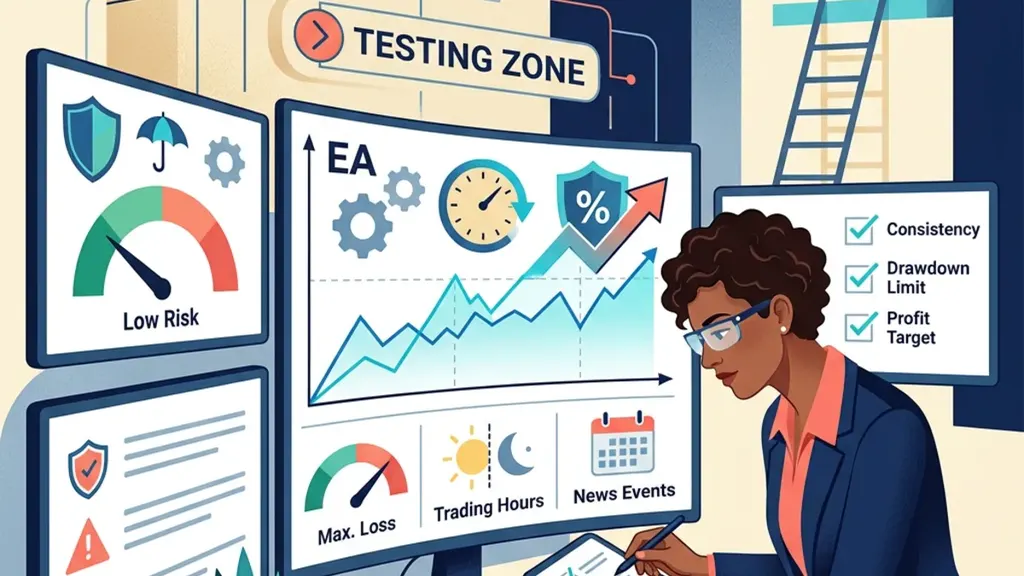
React to losses without recovery escalation
Losing streaks are an unavoidable reality of any trading strategy. The key to success is how you respond to these losses. Many traders fail because they attempt to recover losses by increasing their position sizes, which leads to account destruction. If you are researching how to pass prop firm challenge evaluations programs, you must avoid the trap of recovery escalation at all costs. Maintain your original risk-per-trade settings regardless of whether your last three trades were wins or losses. Consistency is your best friend.
Analyze your losing trades to see if they were caused by a failure in your system or simply a run of bad market luck. A loss that occurs within your predefined strategy limits is not an error, it is a cost of doing business. If the loss was due to an operational issue, however, take steps to fix it before placing another trade. Avoid the emotional urge to make up for the loss quickly. The market does not care about your account's recovery needs.
Stop trading after reaching limits
Consider implementing a hard limit on your daily losses to prevent further damage after a rough patch. If your automated system hits your daily stop-loss limit, shut it down for the remainder of the session. This forces you to remain disciplined and prevents you from making irrational, high-risk trades. The ability to stop and walk away is a professional skill that separates successful traders from those who chase their losses. Always plan your exit before you even open a new position.
Remember that you do not need to hit the target profit in a single week to succeed. Focus on small, steady wins that compound over time without threatening the longevity of your account. By resisting the temptation to recover losses through aggressive betting, you preserve your capital and keep your account in the game longer. This patient approach is essential for achieving your goals in a challenging evaluation environment. Stick to your risk plan and trust in the statistical probability of your system over time.
Plan for consistency requirements
Consistency rules are often designed to prevent traders from using a single lucky day to pass a challenge. You need to understand how your provider measures this consistency. Some firms look at the ratio between your best day and your total profit, while others examine your average daily performance. Before you start, look at the specific formulas the firm uses. If you don't know how to pass prop firm challenge evaluations benchmarks like these, you may end up failing despite reaching the target profit with your account.
Try to maintain a relatively smooth equity curve that does not rely on massive, one-off gains. While large wins look impressive, they can trigger a consistency violation if they represent too high a percentage of your total returns. Diversify your trading activity so that your profit comes from a sequence of well-executed trades rather than a single explosive session. This approach makes it easier to comply with firm rules while still moving steadily toward your profit target in a predictable and controlled manner.
Diversify gains across days
Monitor your best-day-to-total-profit ratio regularly. If you find your profits are too concentrated on a few days, consider scaling back your position sizes on high-volatility days or avoiding certain instruments that tend to produce outlier results. This proactive adjustment can keep you within the rules without forcing you to change your entire trading style. Remember that the goal is to pass the evaluation by demonstrating a sustainable edge, not just by meeting the minimum requirements through aggressive or lucky trading.
If you are concerned about meeting these requirements, run a hypothetical check using your past backtest data. See if your current strategy would have triggered any consistency violations in previous market regimes. If it would have, consider refining your entry or exit rules to smooth out your performance distribution. A well-designed strategy should be capable of hitting the target within the firm's constraints. Always keep these rules in mind as you build your trading plan, as they are non-negotiable for account success.
Respond to a platform or VPS incident
A technical failure can happen at any time, and you must be prepared for the worst. If your VPS goes offline during an active trade, your EA will stop managing your open positions. Knowing how to pass prop firm challenge requirements includes having a contingency plan for these exact moments. Always ensure that your platform has server-side stop-loss and take-profit orders in place before the market moves. Relying on local client-side software for trade protection is a dangerous habit that leaves your account vulnerable during outages.
If you receive an alert that your platform or VPS is down, check your connection status from your mobile device immediately. Have the ability to log in manually to close positions or cancel orders if the EA is failing to respond. Keeping a copy of your login credentials and the firm's support contact information handy is a basic, yet crucial, step. You do not want to be scrambling for information when your account is at risk because of a server-side disconnect or platform crash.
Ensure recovery resilience
Test your recovery process during your demo rehearsal phase. Intentionally disconnect your VPS and observe how your EA re-establishes connectivity once it comes back online. Does it recognize all open orders correctly? Does it duplicate any orders, or does it clean up the mess? These questions define your operational resilience. If your software requires manual intervention to resume after a power or connection loss, make sure you know exactly what steps to take. A slow response can result in avoidable slippage.
Document all technical incidents, including the time, cause, and your specific response. This log is helpful for your own learning and can also be useful if you ever need to explain an unusual trade to the firm's support team. Treat these incidents as reminders that technology is fallible. By having clear, tested procedures for every type of technical failure, you remove the element of surprise from your trading day. This level of preparedness is exactly what is needed to manage a large capital account.
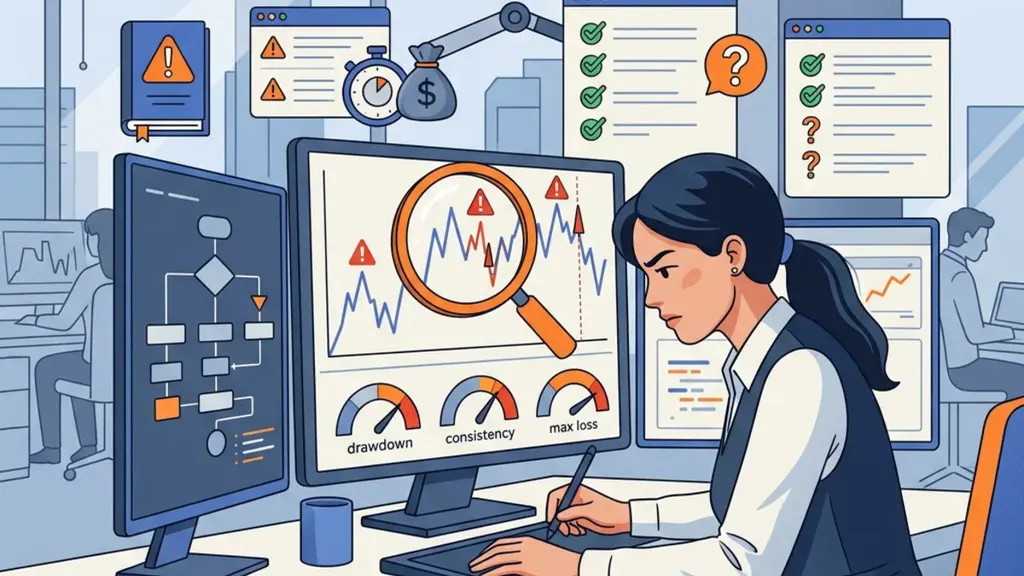
Assess progress without changing the rules
It is tempting to tweak your strategy when you hit a slow period, but frequent changes often lead to disaster. If your system is grounded in a solid hypothesis, you must give it time to work. When learning how to pass prop firm challenge evaluations, patience is usually more valuable than constant optimization. Review your performance on a weekly or monthly basis rather than daily. This prevents you from making rash decisions based on short-term market noise that doesn't actually affect your long-term statistical edge.
Compare your current results against your initial expectations and backtest projections. Are your win rates and average loss sizes within the expected range? If not, investigate the cause before assuming the strategy is broken. Perhaps the current market regime is simply different from the historical data you tested. If the performance gap is significant, revisit your original assumptions. Do not just change settings in the hope of better results. Any modification must be justified by data, tested on a demo account, and documented.
Track changes to avoid errors
Maintain a clear record of every setting change you make. This helps you understand why your performance shifted in one direction or another. If you constantly switch between presets, you will never know which configuration is actually working. A disciplined approach to change management prevents the accumulation of errors. Always verify that your new settings do not conflict with the firm’s trading rules or your own risk management constraints. Small, calculated improvements are always better than sudden, drastic changes to your setup.
Finally, ensure you are not biased by the desire for quick results. Trading is a long-term endeavor, and evaluation periods are just the beginning. Stay focused on your primary objective: proving your strategy can be consistently profitable while adhering to the risk limits. If you have a bad day, look at your long-term stats. If the stats still show a positive expectation, stay the course. By avoiding the urge to change your rules too often, you give your strategy the space to succeed.
Understand the next account stage
Once you finish your evaluation, the next stage brings new challenges and responsibilities. Many traders treat the funded phase as a time to relax, but the reality is that the stakes are higher. You will be managing a larger account with potential for greater risk and reward. Understanding how to pass prop firm challenge evaluations steps is only the start of your journey. You must prepare for the shift in psychology and the potential for stricter rule enforcement that comes with managing actual firm capital.
Review the specific terms for your new account level. These often differ from your evaluation terms, especially regarding drawdown limits or news trading restrictions. Some firms introduce tighter constraints once you move to a funded status. Verify these differences well before you place your first trade in the new stage. A common mistake is to continue trading as if you were still in the evaluation phase, which can lead to quick disqualification or loss of your funded account privileges.
Adjust risk for new balance
Consider your risk management plan for the new account size. A strategy that worked for a $10,000 account may require adjustments when applied to a $50,000 or $100,000 account. You may need to scale down your relative risk per trade to maintain the same level of comfort and to avoid hitting your overall drawdown limits too easily. Use a small demo account or a fresh spreadsheet to simulate your position sizes for the new account balance before going live. This is essential for maintaining control.
Finally, keep your communication with the provider professional and timely. As you move into new stages, you might need to update your documentation or clarify certain rules with their support staff. Being proactive shows that you are a responsible and serious trader. This stage of your journey is where you truly begin to professionalize your workflow. Stay humble, maintain your discipline, and continue to treat every single trade with the same level of rigor that you applied during your evaluation period.
Know when to pause rather than restart immediately
Sometimes the best move in trading is to not trade at all. If you hit a series of losses that leave your account close to the drawdown limit, pause your system. Trying to restart immediately to make up the difference is a recipe for failure. Many people searching for how to complete an automated evaluation guidelines fail because they lack the discipline to stop when they are clearly on the wrong side of the market. A break gives you the space to recalibrate and reset your mindset.
Use your downtime to perform a comprehensive audit of your recent trades. Were your losses a result of poor market conditions, a technical glitch, or a fundamental change in how the asset moves? If you cannot identify the reason, continuing to trade is just gambling. A professional trader views a pause as a tactical decision rather than a failure. It preserves your remaining capital and protects your sanity, both of which are required to succeed when you eventually resume your trading activity.
Reset focus after performance dips
During your pause, look at your overall performance for the month. If your stats are still trending in the right direction, your pause might just be a brief necessary reset. However, if your performance has degraded, use this time to revisit your backtests and check if your strategy needs a major update. Do not feel rushed to restart. The market will always be there tomorrow. The most important thing is that you are in a position to take advantage of the opportunities when they appear.
Finally, make a list of conditions that must be met before you resume. For example, you might decide to wait for a clear trend to emerge or for a specific volatility level to stabilize. This gives you a clear goal and removes the emotional component from your decision. A disciplined restart is much more likely to yield positive results than an impulsive one. By learning when to walk away, you demonstrate that you are in complete control of your trading career.

Common questions
Can an automated system guarantee that I will pass?
No. Markets are inherently unpredictable, and automated systems are subject to slippage, execution delays, and changes in market conditions. No tool can guarantee a pass. To learn how to pass prop firm challenge evaluations, you must focus on building a robust risk management system, verifying current rules, and conducting thorough testing. A professional approach involves managing risk carefully and acknowledging that failure is always a possibility regardless of your chosen software or strategy.
Does my provider allow all types of automated trading?
Not necessarily. Providers often distinguish between permitted strategies and those that violate their terms of service, such as latency arbitrage or prohibited copying services. Before starting, check your provider's specific rules regarding expert advisors. If you are learning how to pass prop firm challenge evaluations, always obtain written confirmation from support if the rules seem unclear. Relying on general assumptions can lead to account termination, so diligence regarding compliance is your responsibility as an account holder.
How should I handle losing streaks during my evaluation?
When you encounter a series of losses, the best action is to pause. Reassess your strategy against the market environment and check if you are still adhering to your risk management rules. Attempting to force a recovery through larger positions is a dangerous mistake. To understand how to pass prop firm challenge evaluations milestones, prioritize staying within your drawdown limits above all else. A disciplined trader accepts small losses, learns from them, and preserves capital for future opportunities.
Are demo accounts accurate enough for testing my strategy?
Demo accounts are useful for testing logic, but they often lack the slippage and execution constraints of live markets. Use them as a first step to ensure your code works correctly, but do not mistake demo results for live performance. If you are researching how to pass prop firm challenge evaluations, treat demo testing as a preliminary phase. Always add a buffer for costs and slippage to your results, as live execution can be far less favorable than a demo simulation.
How do I know if my EA is permitted by my provider?
Check the provider's official terms of service and their FAQ section for their specific policies on automated systems. Do not rely on forum rumors or third-party interpretations. If the policy is unclear, send a direct query to their support email and save their response for your records. Some firms allow EAs but restrict specific types, such as high-frequency trading, arbitrage, or latency exploitation. Always prioritize official documentation over external advice to ensure you do not violate any rules.
What is the biggest risk when using an EA for evaluation?
The biggest risk is operational failure combined with poor risk management. An EA might follow a logical strategy but fail if it doesn't handle slippage, news, or disconnects correctly. If you don't monitor your automated system, a single technical error or an unexpected market move can breach your drawdown limits instantly. You are responsible for the outcome even when the software places the trades, so you must always maintain manual oversight and keep your risk-per-trade within your predefined account limits.
Why is my backtest showing different results than my forward demo test?
Backtests often use idealized conditions, including perfect execution, fixed spreads, and zero slippage, which don't exist in a live environment. Your forward test is more realistic because it incorporates real market noise, varying liquidity, and execution delays. If your forward test is underperforming, examine your transaction costs, tick quality, and how the EA handles market orders. Never assume your backtest will perfectly replicate in real-time. Use your demo test as a realistic baseline for your performance and adjust your expectations accordingly.
Should I change my strategy if I miss my daily target?
No. A single day of missing a target is rarely enough evidence to conclude that your entire strategy is broken. Markets move in cycles, and volatility fluctuates daily. If you find yourself constantly missing targets, review your long-term performance statistics over a representative period. Check if the drawdown is still within your acceptable limits and if your expectancy remains positive. Only modify your strategy if you can prove, through data and testing, that a structural change will actually improve your long-term results.